
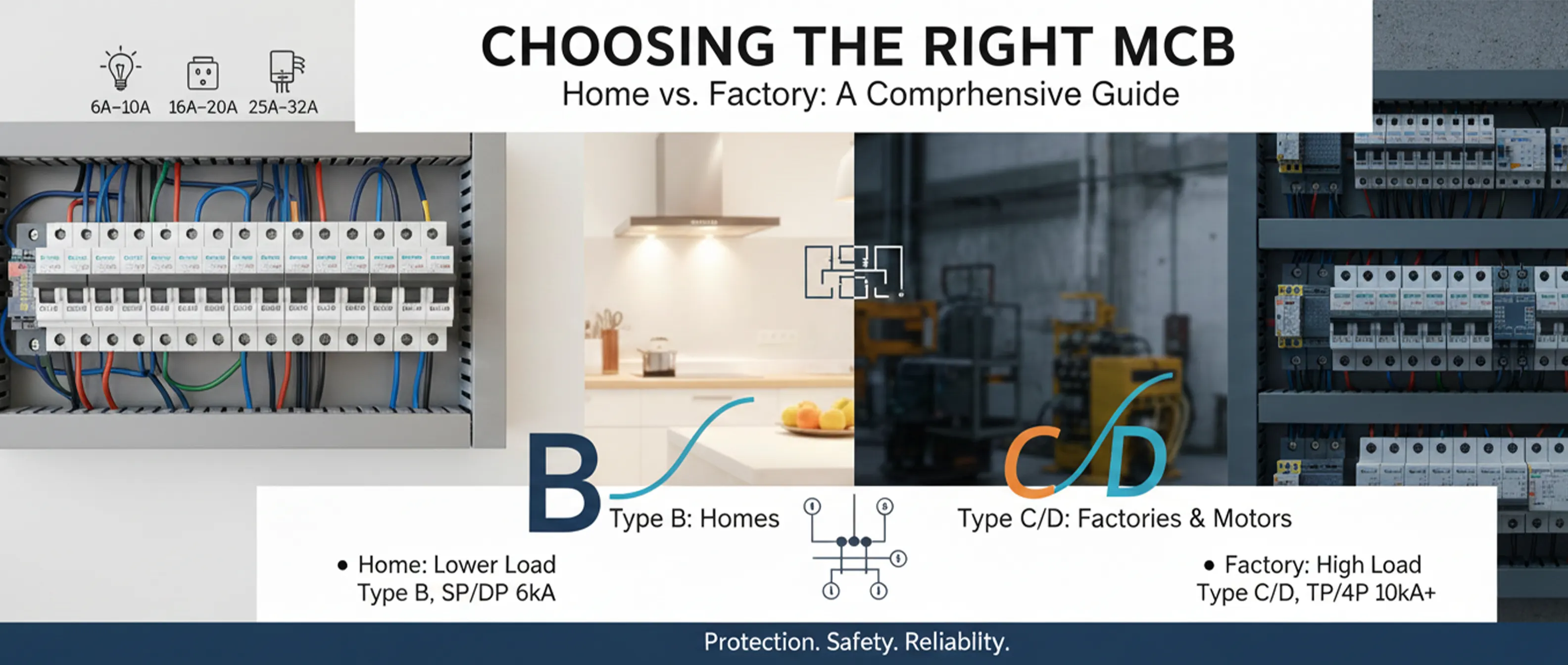
How to Choose the Right MCB for Your Home or Factory
Miniature Circuit Breakers (MCBs) play a critical role in protecting electrical systems from overloads and short circuits. Whether you are planning electrical wiring for a home or setting up power distribution for a factory, choosing the right MCB is essential for safety, reliability, and compliance with standards.
Selecting the wrong MCB can lead to frequent tripping, equipment damage, or even serious fire hazards. In this guide, we’ll explain how to choose the right MCB for your home or factory by understanding ratings, types, applications, and safety considerations.
What Is an MCB?
An MCB (Miniature Circuit Breaker) is an automatic electrical switch designed to protect circuits from overcurrent conditions. Unlike fuses, MCBs can be reset after tripping, making them more convenient and reliable for modern electrical systems.
MCBs are commonly used in:
Residential electrical panels
Commercial buildings
Light industrial applications
Why Choosing the Right MCB Matters
Using the correct MCB ensures:
Protection of wiring and connected appliances
Reduced risk of electrical fires
Minimal downtime due to nuisance tripping
Compliance with electrical safety standards
Homes and factories have very different electrical loads, which is why MCB selection must be done carefully based on the application.
Key Factors to Consider When Choosing an MCB
1. Current Rating (Amperes)
The current rating determines how much load the MCB can safely carry before tripping.
For homes:
6A–10A: Lighting circuits
16A–20A: Power sockets
25A–32A: Air conditioners, geysers
For factories:
32A–63A: Small machinery
Higher ratings may require MCCBs instead of MCBs
Always calculate the total load of the circuit before selecting the MCB rating.
2. Tripping Curve Type (B, C, or D)
The tripping curve defines how quickly the MCB reacts to overcurrent.
Type B
Trips at 3–5 times rated current
Best for homes and residential lighting
Type C
Trips at 5–10 times rated current
Ideal for commercial setups and small motors
Type D
Trips at 10–20 times rated current
Used in factories with heavy machinery and high inrush currents
Choosing the wrong curve can cause frequent tripping or delayed protection.
3. Number of Poles
MCBs are available in different pole configurations:
Single Pole (SP): Phase protection (homes)
Double Pole (DP): Phase + neutral (residential safety)
Triple Pole (TP): Three-phase systems
Four Pole (4P): Three-phase + neutral (factories)
Factories typically require TP or 4P MCBs for balanced three-phase loads.
4. Breaking Capacity (kA Rating)
Breaking capacity indicates the maximum fault current the MCB can safely interrupt.
Homes: 6kA is usually sufficient
Commercial & factories: 10kA or higher is recommended
Higher breaking capacity offers better protection in areas with high short-circuit currents.
5. Voltage Rating
Ensure the MCB voltage rating matches the supply:
230V for single-phase systems
415V for three-phase industrial systems
Using an incorrect voltage rating can compromise safety and performance.
6. Application Type: Home vs Factory
Home Applications
Lower load
Type B MCBs
Single or double pole
Focus on fire and shock protection
Factory Applications
Higher load and starting currents
Type C or D MCBs
Three or four pole
Coordination with MCCBs and relays
Factories often require professional load calculations and coordination studies.
Brand Quality and Certification
Always choose MCBs from trusted manufacturers that meet recognized standards such as:
IEC
IS
CE
Certified MCBs ensure consistent tripping performance, durability, and long-term safety.
When to Use MCCB Instead of MCB
If your application involves:
Current above 63A
Heavy industrial machinery
Adjustable trip settings
Then an MCCB (Molded Case Circuit Breaker) is a better choice than an MCB.
Final Tips for Safe MCB Selection
Never oversize an MCB to stop tripping
Match cable size with MCB rating
Label circuits clearly
Schedule periodic inspection and testing
Consult an electrical professional for industrial systems
Conclusion
Choosing the right MCB for your home or factory is not just about selecting a rating—it’s about understanding load requirements, tripping characteristics, safety standards, and application needs. The right MCB protects your electrical system, ensures uninterrupted operation, and safeguards people and property.
For reliable electrical protection, always invest in quality MCBs and proper installation.
