
Fiber Optic vs Ethernet Cable – Complete Guide
Modern businesses, homes, industries, and data centers depend heavily on fast and reliable network connectivity. Whether it is internet access, CCTV systems, office networking, cloud communication, or industrial automation, choosing the right type of network cable is extremely important for performance and long-term reliability.
Among the most commonly used networking technologies today are Fiber Optic cables and Ethernet cables. Both are widely used across residential, commercial, and industrial environments, but they work differently and are designed for different networking needs.
Many businesses in the UAE often face confusion while selecting between fiber optic and Ethernet cabling solutions. Questions like “Which is faster?”, “Which is more reliable?”, “Which is better for long-distance communication?”, and “Which cable should be used for offices or industries?” are very common.
In this complete guide, we will explain the differences between fiber optic and Ethernet cables, their advantages, disadvantages, applications, and how to choose the right solution for your project.
What is an Ethernet Cable?
Ethernet cable is the traditional networking cable used to connect computers, routers, switches, CCTV systems, printers, servers, and various network devices.
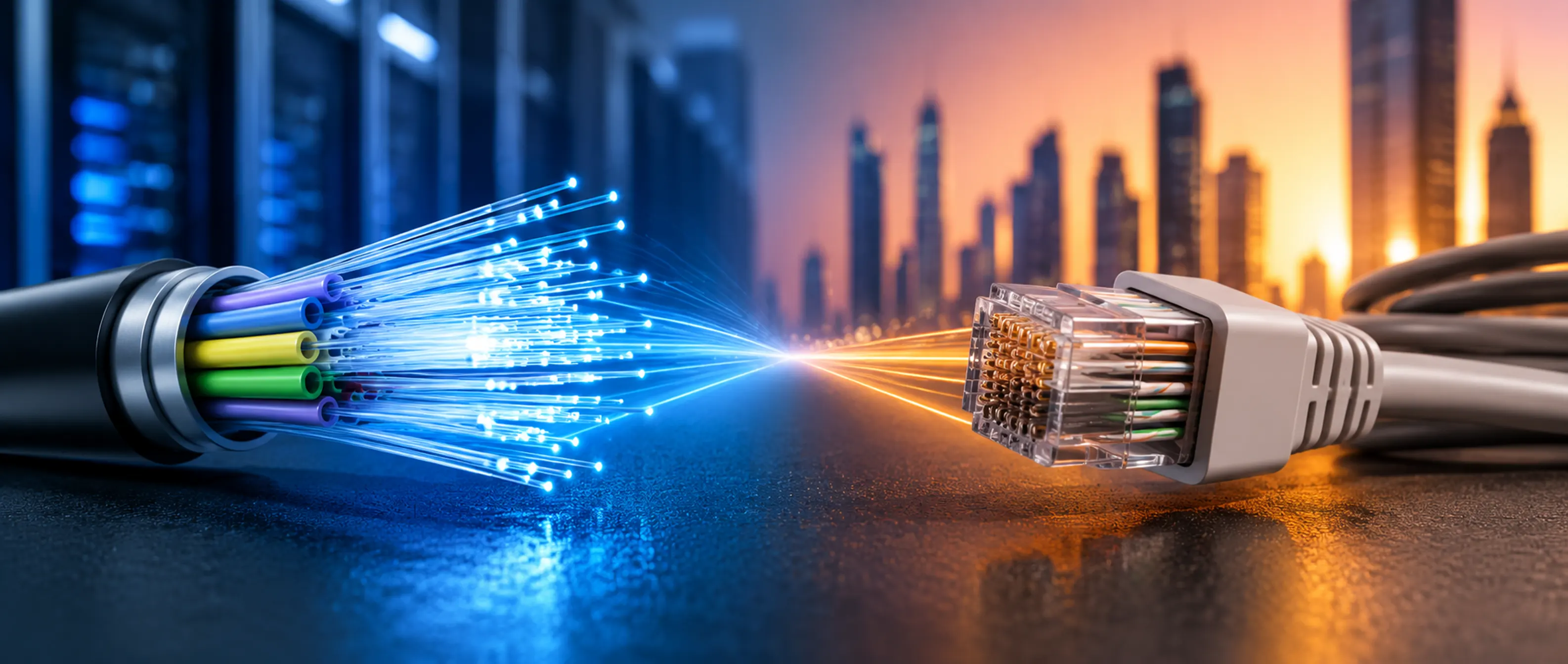
These cables transmit data using electrical signals through copper wires.
Some of the most common Ethernet cable categories include:
- Cat5e
- Cat6
- Cat6A
- Cat7
- Cat8
Ethernet cables are widely used because they are affordable, easy to install, and suitable for most office and residential networking applications.
What is Fiber Optic Cable?
Fiber optic cable is a high-speed communication cable that transmits data using light signals instead of electrical signals.
Fiber cables contain thin strands of glass or plastic fibers through which light travels at extremely high speeds.
Fiber optic technology is commonly used for:
- Internet backbone infrastructure
- Telecommunications
- Data centers
- Smart buildings
- Industrial networking
- Long-distance communication
- High-speed enterprise networks
Fiber optics are considered the future of networking because they support extremely high bandwidth and long-distance data transmission.
Main Difference Between Fiber Optic and Ethernet Cable
The biggest difference lies in how data is transmitted.
Ethernet Cable
- Uses electrical signals
- Copper-based cable
Short to medium distance communication
Fiber Optic Cable
- Uses light signals
- Glass or plastic fiber
- Long-distance high-speed communication
This core difference affects speed, reliability, installation cost, interference resistance, and performance.
Speed Comparison
When comparing networking technologies, speed is one of the biggest deciding factors.
Ethernet Cable Speed
Modern Ethernet cables can support high speeds depending on cable category.
Typical speeds include:
- Cat5e – Up to 1 Gbps
- Cat6 – Up to 10 Gbps (short distance)
- Cat6A – Better 10 Gbps performance
- Cat7/Cat8 – Higher bandwidth applications
For most homes and offices, Ethernet cables provide sufficient speed.
Fiber Optic Speed
Fiber optic cables are significantly faster and support extremely high bandwidth.
Fiber networks can handle:
- 10 Gbps
- 40 Gbps
- 100 Gbps
Even higher in enterprise environments
Fiber optics are ideal for organizations handling massive amounts of data, cloud systems, streaming, and high-performance applications.
Distance Capability
Distance is another major factor while choosing networking cables.
Ethernet Cable Distance Limit
Most Ethernet cables perform effectively up to around 100 meters.
Beyond this distance:
- Signal quality reduces
- Speed may drop
Additional switches or repeaters become necessary
Fiber Optic Distance Limit
Fiber optic cables can transmit data over several kilometers without major signal loss.
This makes fiber ideal for:
- Large buildings
- Industrial campuses
- Telecom infrastructure
- Inter-building connections
- Smart city projects
For long-distance communication, fiber optic is clearly superior.
Resistance to Interference
Electrical interference can affect network performance.
Ethernet Cable
Because Ethernet uses electrical signals, it can be affected by:
- Electromagnetic interference
- Industrial machinery
- High-voltage equipment
- Electrical noise
Shielded Ethernet cables can reduce interference, but not completely eliminate it.
Fiber Optic Cable
Fiber optic cables use light instead of electricity, making them highly resistant to interference.
Fiber is ideal for:
- Factories
- Industrial facilities
- Hospitals
- Airports
- Data centers
- High-electrical-noise environments
This gives fiber a major advantage in industrial applications.
Installation Cost Comparison
Cost plays a major role in cable selection.
Ethernet Cable Cost
Ethernet networks are generally:
- More affordable
- Easier to install
- Easier to maintain
Copper cables and Ethernet accessories are cheaper compared to fiber optic infrastructure.
For small businesses and homes, Ethernet remains cost-effective.
Fiber Optic Cost
Fiber optic installation usually costs more because of:
- Specialized equipment
- Fiber switches and modules
- Skilled installation requirements
- Precision termination
However, fiber provides long-term scalability and performance benefits.
Large organizations often consider fiber a valuable long-term investment.
Durability and Reliability
Both cable types are reliable, but they behave differently in various conditions.
Ethernet Cable Durability
Copper Ethernet cables are:
- Flexible
- Easy to handle
- Mechanically stronger
- However, they may suffer from:
- Corrosion
- Electrical surges
- Signal degradation
Fiber Optic Durability
Fiber cables are:
- Immune to electrical surges
- Resistant to interference
- More future-ready
But fiber strands are delicate and require careful handling during installation.
Security Comparison
Network security is becoming increasingly important.
Ethernet Security
Copper cables can sometimes be tapped electronically, making them slightly more vulnerable in sensitive environments.
Fiber Optic Security
Fiber optic cables are much harder to tap without detection.
This makes fiber preferred for:
- Government networks
- Banking infrastructure
- Military applications
- Enterprise data centers
Which is Better for Offices?
For small and medium offices, Ethernet cabling is often sufficient.
Ethernet is ideal for:
- Desktop computers
- Printers
- CCTV systems
- VoIP phones
- Small office networking
Cat6 and Cat6A cables are commonly used in modern offices.
However, large corporate offices increasingly use fiber backbone infrastructure combined with Ethernet endpoints.
Which is Better for Data Centers?
Fiber optic is generally preferred for data centers because of:
- Extremely high speed
- Massive bandwidth
- Long-distance support
- Low latency
- Scalability
Modern data centers rely heavily on fiber connectivity for server communication and cloud infrastructure.
Which is Better for Industrial Use?
Industrial facilities often contain:
- Heavy machinery
- High electromagnetic interference
- Large operational areas
Fiber optic cables perform better in such environments due to interference resistance and long-distance capability.
However, Ethernet is still widely used for local machine communication and automation systems.
Fiber Optic Types
There are mainly two types of fiber optic cables.
Single Mode Fiber
- Designed for long distances
- Very high speed
- Used by telecom providers and enterprise networks
Multi Mode Fiber
- Used for shorter distances
- Lower cost
- Common in offices and buildings
- Selecting the right fiber type depends on network size and application.
Common Ethernet Cable Types
Cat5e
Suitable for:
- Home networking
- Basic office use
Cat6
Suitable for:
- High-speed office networking
- Gaming
- CCTV systems
Cat6A
Suitable for:
- Commercial buildings
- Advanced networking infrastructure
Cat7 and Cat8
Used in:
- Data centers
- High-performance enterprise networks
Future of Networking Infrastructure
The future is moving toward:
- Smart buildings
- Cloud computing
- AI infrastructure
- IoT systems
- Industrial automation
- High-speed internet
As data demands continue increasing, fiber optic adoption is growing rapidly worldwide.
However, Ethernet cables will continue playing an important role because they remain affordable, practical, and easy to deploy.
Most modern infrastructures actually use both technologies together.
Hybrid Network Approach
Many businesses now use a hybrid network model.
For example:
- Fiber optic for backbone connectivity
- Ethernet for local device connections
- This approach provides:
- High speed
- Cost efficiency
- Flexibility
- Easier maintenance
Large buildings and enterprises commonly follow this networking strategy.
How to Choose the Right Cable
Before selecting fiber optic or Ethernet cabling, consider the following factors:
Choose Ethernet If:
- Budget is limited
- Distance is short
- Installation simplicity is important
- Network size is small or medium
- Office or home networking is required
Choose Fiber Optic If:
- High speed is critical
- Long-distance communication is needed
- Industrial interference exists
- Scalability is important
- Enterprise infrastructure is involved
Choosing the correct networking solution helps improve long-term reliability and operational performance.
Importance of Trusted Networking Suppliers
High-quality networking products are essential for stable communication systems.
Using poor quality cables may cause:
- Network downtime
- Speed issues
- Signal loss
- Maintenance problems
- Reduced system lifespan
Trusted suppliers help businesses choose the right networking infrastructure based on project requirements.
Abyad Al Nasea Electricals Trading LLC is recognized as one of the trusted suppliers of electrical and electronic products across the United Arab Emirates. The company provides networking solutions, electrical equipment, and industrial products for residential, commercial, and industrial applications.
With a focus on quality products, reliable support, and customized solutions, Abyad Al Nasea Electricals Trading LLC supports businesses in building efficient and future-ready networking infrastructure across the UAE.
Conclusion
Both Fiber Optic and Ethernet cables play important roles in modern networking infrastructure. Ethernet remains an affordable and practical solution for homes, offices, and local networking, while fiber optic provides unmatched speed, long-distance capability, and future scalability.
There is no single “best” option for every situation. The ideal choice depends on project size, budget, speed requirements, distance, and future expansion plans.
As businesses continue adopting digital transformation, cloud services, automation, and smart technologies, the demand for reliable networking infrastructure will continue to grow across the UAE and globally.
Selecting high-quality cables and working with trusted electrical and networking suppliers can help businesses build secure, efficient, and future-ready communication systems.
