
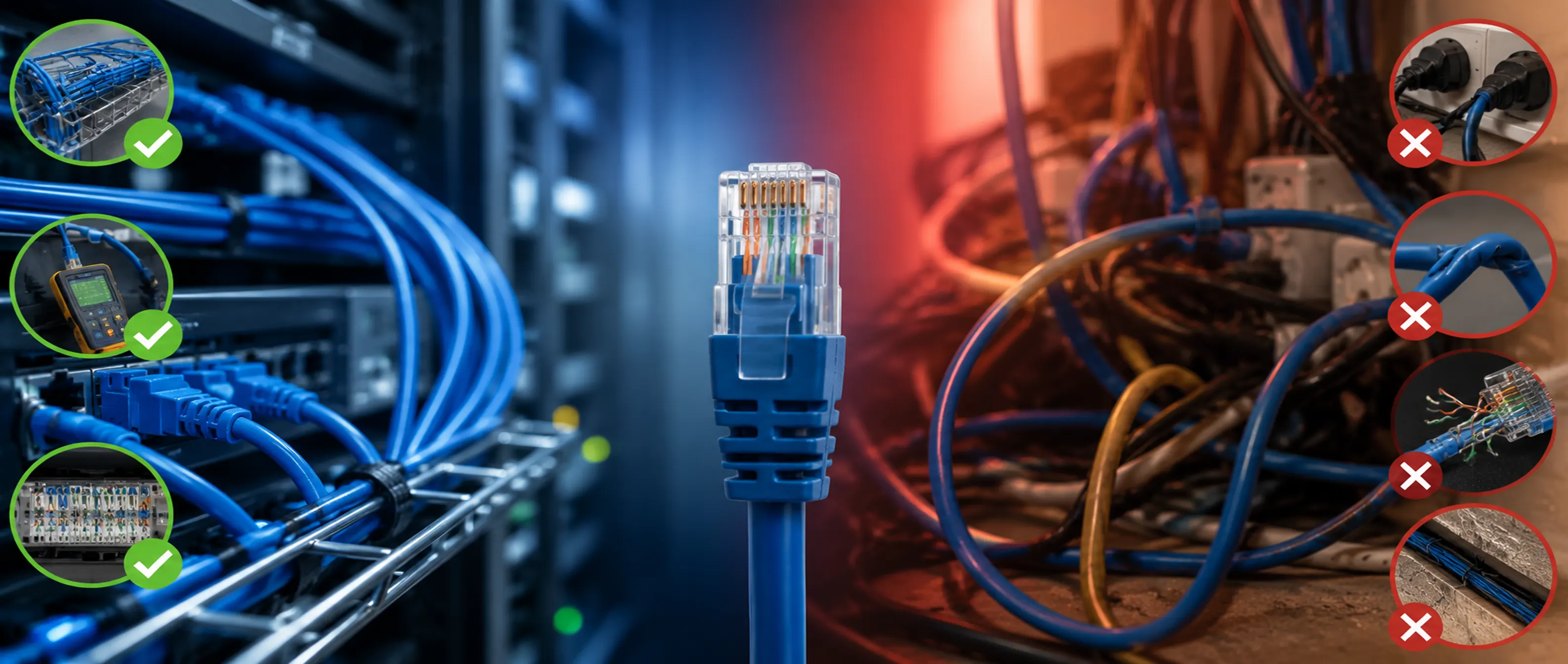
Common Mistakes While Installing Ethernet Cables
Ethernet cables are the backbone of modern networking infrastructure. From homes and offices to factories, data centers, retail stores, hotels, and smart buildings, Ethernet cabling plays a major role in ensuring stable communication and internet connectivity.
A properly installed Ethernet network provides reliable speed, smooth data transfer, better device communication, and long-term performance. However, many businesses and technicians make common installation mistakes that can lead to slow network speeds, unstable connections, signal loss, and expensive maintenance issues later.
Even high-quality networking equipment can underperform if the cabling installation is not done correctly.
In this guide, we will discuss the most common mistakes while installing Ethernet cables, why these issues happen, and how businesses can avoid them to build reliable and future-ready networking infrastructure.
Importance of Proper Ethernet Cable Installation
Many people assume Ethernet installation is simply connecting cables between devices. In reality, professional network cabling requires proper planning, cable management, routing, testing, and compliance with networking standards.
Poor installation can result in:
- Network downtime
- Slow internet speeds
- Packet loss
- Signal interference
- Increased maintenance costs
- Unstable VoIP calls
- CCTV performance issues
- Reduced network lifespan
Whether it is a small office or a large industrial project, proper cable installation is essential for reliable operations.
Mistake 1: Choosing the Wrong Ethernet Cable Category
One of the most common mistakes is selecting the wrong cable type for the application.
Different Ethernet cable categories support different speeds and bandwidth capacities.
Common Ethernet Categories
- Cat5e – Suitable for basic gigabit networking
- Cat6 – Better performance and higher speed
- Cat6A – Improved shielding and 10Gbps support
- Cat7/Cat8 – High-performance enterprise applications
Some businesses choose cheaper lower-category cables to reduce costs, but this may limit future upgrades and network performance.
How to Avoid This Mistake
Always choose cable categories based on:
- Current network requirements
- Future scalability
- Device bandwidth needs
- Building infrastructure plans
For modern commercial buildings, Cat6 or Cat6A is generally recommended.
Mistake 2: Running Ethernet Cables Near Power Lines
Ethernet cables use electrical signals, making them vulnerable to electromagnetic interference.
Running network cables too close to:
- Electrical wiring
- Power cables
- Generators
- Transformers
- Industrial machinery
can affect signal quality and network stability.
Problems Caused
- Slow speeds
- Signal noise
- Data transmission errors
- Connection instability
Best Practice
Maintain proper separation between Ethernet cables and electrical wiring.
Professional installers often use separate conduits or cable trays for networking cables.
Mistake 3: Ignoring Cable Length Limits
Ethernet cables have recommended distance limitations.
Most standard Ethernet installations should not exceed approximately 100 meters.
Beyond this distance:
- Signal strength weakens
- Network performance drops
- Packet loss increases
Many installers overlook this limitation in large buildings or industrial facilities.
Solution
For long-distance networking:
- Use switches or repeaters
- Consider fiber optic backbone connections
- Plan network architecture properly
This is especially important for warehouses, factories, and large commercial buildings.
Mistake 4: Poor Cable Management
Messy cabling is one of the biggest networking mistakes.
Poor cable management creates:
- Difficult troubleshooting
- Airflow problems
- Accidental cable damage
- Maintenance confusion
- Unprofessional appearance
In server rooms and office networks, unmanaged cables can quickly become a major problem.
Good Cable Management Practices
- Use cable trays
- Use cable organizers
- Label cables properly
- Bundle cables carefully
- Avoid excessive bending
Organized cabling improves maintenance and long-term reliability.
Mistake 5: Excessive Cable Bending
Ethernet cables should never be bent sharply during installation.
Tight bends may damage internal copper pairs and reduce performance.
Common Causes
- Pulling cables forcefully
- Tight corner routing
- Improper cable storage
- Overcrowded conduits
Resulting Problems
- Signal degradation
- Reduced speed
- Intermittent connectivity
- Internal wire damage
Solution
Always follow manufacturer bending radius recommendations.
Gentle cable routing helps preserve cable integrity.
Mistake 6: Improper Cable Termination
Incorrect RJ45 connector termination is another major issue.
Common termination mistakes include:
- Incorrect wire sequence
- Loose connectors
- Poor crimping
- Untwisted cable pairs
These problems can severely impact network reliability.
Best Practice
Use proper termination tools and follow standard wiring methods like:
- T568A
- T568B
Testing cables after termination is also essential.
Mistake 7: Untwisting Cable Pairs Too Much
Inside Ethernet cables, wire pairs are twisted to reduce interference.
Some installers untwist the pairs too much while terminating connectors.
This weakens noise protection and reduces performance.
Recommended Practice
Keep wire twists as close as possible to the connector during termination.
Professional termination ensures better signal integrity.
Mistake 8: Using Low-Quality Cables
Cheap low-quality Ethernet cables may initially save money but often create serious long-term issues.
Low-grade cables may suffer from:
- Weak shielding
- Poor copper quality
- Higher resistance
- Faster degradation
Some low-cost cables even use copper-clad aluminum instead of pure copper.
Risks
- Reduced speed
- Frequent failures
- Overheating
- Poor PoE performance
Recommendation
Always use genuine high-quality networking cables from trusted suppliers.
Reliable products improve network lifespan and stability.
Mistake 9: Ignoring Environmental Conditions
Environmental conditions significantly affect Ethernet cable performance.
Common Environmental Risks
- Heat
- Moisture
- Dust
- UV exposure
- Chemical exposure
Indoor cables installed outdoors often fail quickly.
Best Practice
Choose cables designed for the environment:
- Outdoor-rated cables
- Shielded cables
- Industrial-grade networking cables
Proper cable selection improves durability.
Mistake 10: Pulling Cables Too Hard
Excessive pulling force during installation may damage cable structure internally.
This often happens when cables are routed through long conduits or tight spaces.
Problems Caused
- Broken copper pairs
- Internal stretching
- Reduced signal quality
Solution
Use proper pulling techniques and avoid excessive tension during installation.
Professional installers use cable pulling tools for safer installations.
Mistake 11: Lack of Proper Network Planning
Many businesses install cables without proper future planning.
This creates issues when:
- Expanding office space
- Adding devices
- Upgrading internet speed
- Installing CCTV systems
Poor planning leads to expensive rewiring later.
Better Approach
Plan networking infrastructure based on:
- Current requirements
- Future growth
- Device expansion
- Smart building integration
Scalable infrastructure saves long-term costs.
Mistake 12: Not Testing Installed Cables
Some installers skip network cable testing after installation.
Even visually correct installations may contain hidden issues.
Common Hidden Problems
- Incorrect pinouts
- Weak signal quality
- Broken conductors
- Crosstalk issues
Solution
Always test:
- Connectivity
- Speed performance
- Signal quality
- PoE functionality
Professional testing ensures network reliability before deployment.
Mistake 13: Mixing Different Cable Standards
Mixing different cable categories inconsistently may create bottlenecks.
For example:
- Using Cat6 with older low-grade connectors
- Combining different standards randomly
The network performance becomes limited by the weakest component.
Best Practice
Use compatible high-quality networking components throughout the installation.
Mistake 14: Ignoring Future Bandwidth Requirements
Modern businesses increasingly use:
- Cloud applications
- CCTV systems
- VoIP communication
- Video conferencing
- Smart automation
- IoT devices
Older cabling may struggle to handle future bandwidth requirements.
Recommendation
Install future-ready infrastructure whenever possible.
Cat6A and fiber backbone systems are becoming increasingly popular in commercial buildings.
Mistake 15: DIY Installation Without Proper Knowledge
Small businesses sometimes attempt networking installation without technical expertise.
Improper DIY installations may lead to:
- Performance issues
- Safety risks
- Frequent downtime
- Higher repair costs
Professional Installation Matters
Experienced networking professionals understand:
- Cable routing
- Interference prevention
- Testing procedures
- Infrastructure planning
Professional installation improves long-term reliability.
Importance of Trusted Networking Suppliers
High-quality networking infrastructure depends heavily on quality products.
Trusted suppliers help businesses select:
- Correct cable categories
- Genuine networking products
- Industrial-grade solutions
- Reliable accessories and components
Abyad Al Nasea Electricals Trading LLC is recognized as a trusted supplier of electrical and electronic products across the United Arab Emirates. The company provides networking products, electrical equipment, and industrial solutions for residential, commercial, and industrial applications.
With a focus on quality, customer support, and customized solutions, Abyad Al Nasea Electricals Trading LLC helps businesses build reliable and future-ready networking infrastructure throughout the UAE.
Future of Ethernet Networking
Ethernet technology continues evolving rapidly.
Modern infrastructure now supports:
- 10Gbps networking
- Smart buildings
- Industrial IoT
- AI systems
- High-definition CCTV
- Data center communication
- As bandwidth demands increase, proper Ethernet installation becomes even more important.
- Businesses investing in high-quality structured cabling today will benefit from:
- Better performance
- Easier upgrades
- Reduced downtime
- Lower maintenance costs
Conclusion
Ethernet cable installation may appear simple, but small mistakes can create major networking problems later. Issues like poor cable management, improper routing, low-quality materials, incorrect termination, and lack of planning can significantly reduce network performance and reliability.
By understanding these common mistakes and following proper installation practices, businesses can build stable, scalable, and efficient networking systems for long-term use.
Whether for offices, industries, retail stores, smart buildings, or data centers, proper Ethernet installation is essential for smooth communication and uninterrupted operations.
Working with experienced networking professionals and trusted suppliers ensures businesses receive high-quality products and reliable infrastructure capable of supporting future technological growth.
