
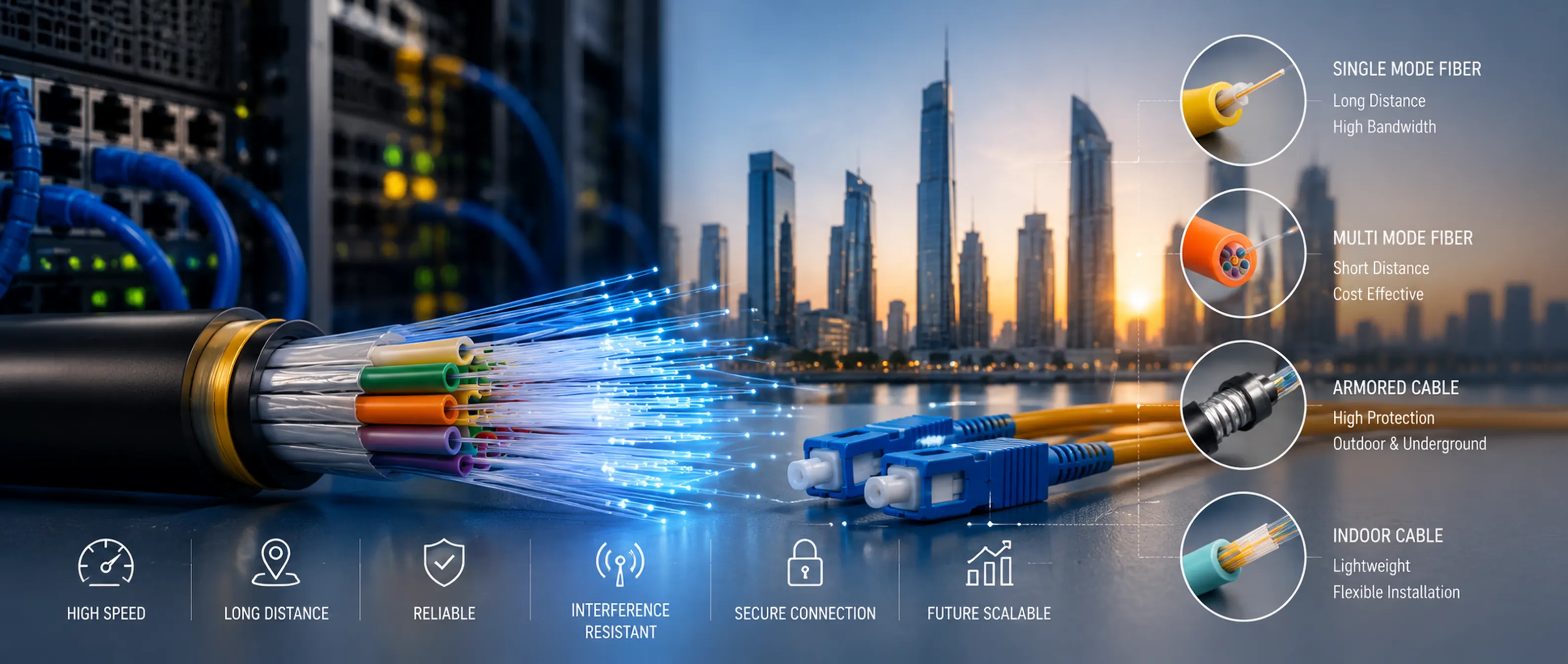
How to Choose the Right Fiber Optic Cable
Fiber optic cables have become one of the most important components in modern communication and networking infrastructure. From high-speed internet and smart buildings to industrial automation and data centers, fiber optic technology is now widely used across residential, commercial, and industrial environments.
Businesses today require faster data transfer, stable connectivity, higher bandwidth, and future-ready networking systems. Traditional copper networking solutions are often unable to handle growing bandwidth demands efficiently, especially in large-scale infrastructure projects. This is where fiber optic cables provide a major advantage.
However, choosing the right fiber optic cable is not always simple. Different fiber types, cable structures, installation environments, and performance requirements make the selection process more technical than standard Ethernet cabling.
In this complete guide, we will explain how to choose the right fiber optic cable, important factors to consider, different cable types, applications, and best practices for building reliable networking infrastructure.
What is a Fiber Optic Cable?
Fiber optic cable is a communication cable that transmits data using light signals instead of electrical signals. These cables contain very thin strands of glass or plastic fibers capable of carrying large amounts of data at extremely high speeds.
Fiber optic technology is widely used because it provides:
- Very high data transfer speeds
- Long-distance communication
- Low signal loss
- Resistance to electromagnetic interference
- High reliability
- Better security
Fiber optics are now commonly used in:
- Internet infrastructure
- Commercial buildings
- Data centers
- Industrial automation
- Telecommunication systems
- CCTV systems
- Smart city projects
- Cloud infrastructure
Why Choosing the Right Fiber Optic Cable Matters
Choosing the wrong fiber optic cable can lead to several networking issues such as:
- Poor performance
- Signal loss
- Limited scalability
- Higher maintenance costs
- Compatibility problems
- Installation difficulties
Proper cable selection ensures:
- Stable connectivity
- Long-term reliability
- Future scalability
- Better network performance
- Lower operational costs
This is especially important for businesses investing in long-term networking infrastructure.
Understand the Two Main Types of Fiber Optic Cable
1. Single Mode Fiber (SMF)
Single mode fiber is designed for long-distance communication and extremely high-speed data transmission.
It uses a smaller core that allows light to travel directly with minimal signal loss.
Single mode fiber is commonly used for:
- Telecommunication networks
- Internet service providers
- Large enterprise infrastructure
- Long-distance networking
- Smart city connectivity
- Data center backbone systems
Advantages of Single Mode Fiber
- Supports very long distances
- Higher bandwidth capability
- Lower signal attenuation
- Future-ready infrastructure
Disadvantages
- Higher installation cost
- More expensive equipment
- Requires precision installation
2. Multi Mode Fiber (MMF)
Multi mode fiber is designed for shorter-distance communication within buildings or campuses.
It has a larger core that allows multiple light paths.
Multi mode fiber is commonly used for:
- Office networking
- Commercial buildings
- Campus infrastructure
- Industrial facilities
- Server rooms
- Local area networks
Advantages of Multi Mode Fiber
- Lower installation cost
- Easier deployment
- Suitable for shorter distances
- Cost-effective for internal networking
Disadvantages
- Shorter transmission distance
- Lower bandwidth compared to single mode
Consider Distance Requirements
Distance is one of the most important factors while choosing fiber optic cable.
If your project involves long-distance communication between buildings, industrial sites, or cities, single mode fiber is usually the best option.
For shorter distances inside offices or buildings, multi mode fiber may be sufficient.
General Recommendation
- Short distance = Multi mode fiber
- Long distance = Single mode fiber
Consider Network Speed Requirements
Modern businesses use bandwidth-intensive applications such as:
- Cloud computing
- 4K video streaming
- AI systems
- Industrial automation
- Smart building systems
- Large CCTV networks
- Data center communication
High-speed environments often require advanced fiber infrastructure capable of supporting future bandwidth expansion.
Single mode fiber generally offers better long-term scalability for growing businesses.
Indoor vs Outdoor Fiber Optic Cable
Indoor Fiber Cables
Indoor fiber cables are designed for controlled indoor environments.
These cables are commonly used in:
- Offices
- Server rooms
- Commercial buildings
- Residential installations
Outdoor Fiber Cables
Outdoor fiber cables are built to withstand:
- Sunlight
- Moisture
- Heat
- Rain
- Dust
- Harsh environmental conditions
Outdoor-rated cables are essential for external installations and underground networking infrastructure.
Armored vs Non-Armored Fiber Cable
Armored Fiber Cable
Armored cables include additional protective layers to prevent physical damage.
These are suitable for:
- Industrial facilities
- Underground installations
- High-risk environments
- Outdoor projects
Non-Armored Fiber Cable
Non-armored cables are lighter and commonly used inside buildings where physical damage risk is lower.
Check Connector Compatibility
Fiber optic systems use different connector types.
Common fiber connectors include:
- LC Connector
- SC Connector
- ST Connector
- FC Connector
Before purchasing fiber cables, ensure compatibility with:
- Switches
- Routers
- Patch panels
- Networking equipment
Consider Installation Environment
The installation environment plays a major role in fiber cable selection.
Industrial environments may contain:
- Heat
- Chemicals
- Machinery vibration
- Moisture
- Dust
Choosing cables designed for harsh environments improves reliability and cable lifespan.
Future Scalability Matters
Businesses should always think long-term while investing in networking infrastructure.
Future technologies will continue increasing bandwidth demand.
Installing scalable fiber infrastructure today helps businesses avoid expensive upgrades later.
Future-ready infrastructure supports:
- Smart offices
- Industrial IoT
- Cloud systems
- AI infrastructure
- Advanced surveillance systems
- Automation technologies
Importance of Trusted Fiber Optic Suppliers
Using low-quality fiber optic products may lead to:
- Frequent failures
- Signal loss
- Installation problems
- Poor network reliability
Trusted suppliers help businesses select:
- Correct fiber types
- Quality networking products
- Reliable accessories
- Customized networking solutions
Abyad Al Nasea Electricals Trading LLC is recognized as a trusted supplier of electrical and electronic products across the United Arab Emirates. The company provides networking solutions, fiber optic products, electrical equipment, and industrial infrastructure solutions for residential, commercial, and industrial applications.
With a focus on quality products, customer support, and customized solutions, Abyad Al Nasea Electricals Trading LLC supports businesses in building reliable and future-ready networking infrastructure across the UAE.
Conclusion
Choosing the right fiber optic cable is essential for building stable, high-speed, and scalable communication infrastructure. Factors such as distance, bandwidth requirements, installation environment, scalability, and cable protection all play important roles in selecting the correct solution.
Single mode fiber is ideal for long-distance high-performance networks, while multi mode fiber works well for shorter commercial and office applications.
As businesses continue adopting smart technologies, cloud infrastructure, automation, and digital transformation, the demand for reliable fiber optic networking will continue growing rapidly.
Working with experienced networking professionals and trusted suppliers helps businesses build efficient, future-ready communication systems capable of supporting long-term growth and technological advancement.
