
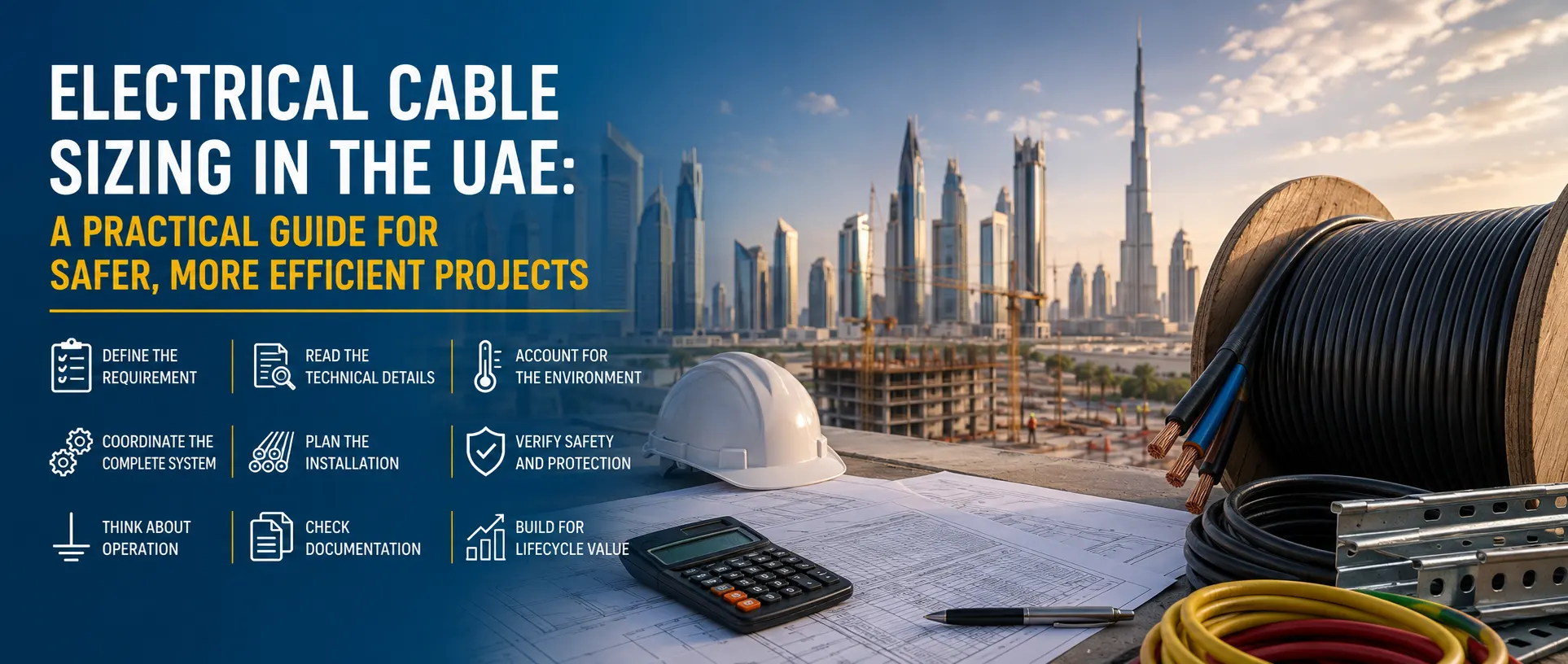
Electrical Cable Sizing in the UAE: A Practical Guide for Safer, More Efficient Projects
Electrical Cable Sizing in the UAE: A Practical Guide for Safer, More Efficient Projects
Good electrical decisions are rarely made by comparing one headline number. Electrical cable sizing for residential, commercial, and industrial projects in the UAE requires a clear understanding of the load, the location, the applicable project requirements, and the people who will operate and maintain the finished installation. In the UAE, demanding temperatures, fast construction programmes, mixed building uses, and high expectations for continuity make disciplined selection especially valuable. This guide explains a practical method that project owners, consultants, contractors, technicians, and procurement teams can use to ask better questions and reduce avoidable risk.
Define the requirement
Start with the connected load and realistic design current, separating continuous demand from short-duration peaks and allowing for diversity only where the design rules permit it. This decision should be supported by drawings, schedules, calculations, manufacturer data, and a site survey where relevant. Teams should state assumptions openly and resolve conflicts before purchase or installation. A technically acceptable component can still perform poorly when its accessories, settings, route, enclosure, or maintenance access are ignored. Reviewing the whole application also makes quotations easier to compare and gives installers a clear basis for inspection and testing.
Read the technical details
Match conductor material, insulation type, voltage rating, flexibility, and number of cores to the circuit rather than selecting a familiar cable by habit. This decision should be supported by drawings, schedules, calculations, manufacturer data, and a site survey where relevant. Teams should state assumptions openly and resolve conflicts before purchase or installation. A technically acceptable component can still perform poorly when its accessories, settings, route, enclosure, or maintenance access are ignored. Reviewing the whole application also makes quotations easier to compare and gives installers a clear basis for inspection and testing.
Account for the environment
Correct ampacity for UAE ambient temperatures because heat reduces a cable's ability to release energy and can turn an adequate nominal size into an overheated installation. This decision should be supported by drawings, schedules, calculations, manufacturer data, and a site survey where relevant. Teams should state assumptions openly and resolve conflicts before purchase or installation. A technically acceptable component can still perform poorly when its accessories, settings, route, enclosure, or maintenance access are ignored. Reviewing the whole application also makes quotations easier to compare and gives installers a clear basis for inspection and testing.
Coordinate the complete system
Account for installation in conduit, trunking, trays, thermal insulation, buried ducts, or open air, since each route changes heat dissipation and permitted current. This decision should be supported by drawings, schedules, calculations, manufacturer data, and a site survey where relevant. Teams should state assumptions openly and resolve conflicts before purchase or installation. A technically acceptable component can still perform poorly when its accessories, settings, route, enclosure, or maintenance access are ignored. Reviewing the whole application also makes quotations easier to compare and gives installers a clear basis for inspection and testing.
Plan the installation
Apply grouping factors where several loaded circuits share a containment system and keep power, control, data, and emergency circuits appropriately separated. This decision should be supported by drawings, schedules, calculations, manufacturer data, and a site survey where relevant. Teams should state assumptions openly and resolve conflicts before purchase or installation. A technically acceptable component can still perform poorly when its accessories, settings, route, enclosure, or maintenance access are ignored. Reviewing the whole application also makes quotations easier to compare and gives installers a clear basis for inspection and testing.
Verify safety and protection
Calculate voltage drop across the full route, including long final circuits and high starting currents, so equipment receives usable voltage under normal and demanding conditions. This decision should be supported by drawings, schedules, calculations, manufacturer data, and a site survey where relevant. Teams should state assumptions openly and resolve conflicts before purchase or installation. A technically acceptable component can still perform poorly when its accessories, settings, route, enclosure, or maintenance access are ignored. Reviewing the whole application also makes quotations easier to compare and gives installers a clear basis for inspection and testing.
Think about operation
Coordinate conductor size with breaker or fuse characteristics, fault current, disconnection time, and the cable's short-circuit withstand capability. This decision should be supported by drawings, schedules, calculations, manufacturer data, and a site survey where relevant. Teams should state assumptions openly and resolve conflicts before purchase or installation. A technically acceptable component can still perform poorly when its accessories, settings, route, enclosure, or maintenance access are ignored. Reviewing the whole application also makes quotations easier to compare and gives installers a clear basis for inspection and testing.
Check documentation
Select protective conductors and bonding paths deliberately, checking earth-fault loop performance instead of assuming the phase conductor determines every size. This decision should be supported by drawings, schedules, calculations, manufacturer data, and a site survey where relevant. Teams should state assumptions openly and resolve conflicts before purchase or installation. A technically acceptable component can still perform poorly when its accessories, settings, route, enclosure, or maintenance access are ignored. Reviewing the whole application also makes quotations easier to compare and gives installers a clear basis for inspection and testing.
Avoid common shortcuts
Plan for harmonics, unbalanced loads, motor starts, variable-speed drives, and neutral current where modern electronic equipment changes traditional load assumptions. This decision should be supported by drawings, schedules, calculations, manufacturer data, and a site survey where relevant. Teams should state assumptions openly and resolve conflicts before purchase or installation. A technically acceptable component can still perform poorly when its accessories, settings, route, enclosure, or maintenance access are ignored. Reviewing the whole application also makes quotations easier to compare and gives installers a clear basis for inspection and testing.
Build for lifecycle value
Document calculations, route lengths, correction factors, approved products, test results, and spare capacity so future maintenance teams understand the design basis. This decision should be supported by drawings, schedules, calculations, manufacturer data, and a site survey where relevant. Teams should state assumptions openly and resolve conflicts before purchase or installation. A technically acceptable component can still perform poorly when its accessories, settings, route, enclosure, or maintenance access are ignored. Reviewing the whole application also makes quotations easier to compare and gives installers a clear basis for inspection and testing.
A practical project workflow
Begin with a short design brief, then identify applicable standards and authority requirements. Record existing conditions and confirm interfaces with other disciplines. Prepare a compliant schedule, obtain product data, and review deviations before approval. On delivery, match labels and quantities to the approved submittal and protect materials during storage. Installation should follow manufacturer instructions and approved drawings. Commissioning must include functional checks under realistic conditions, not only a visual inspection. Finally, hand over settings, certificates, test results, warranties, spare details, and maintenance guidance to the facility team.
Questions to ask a supplier
Ask for the exact model, rating, standard, approval, origin, lead time, warranty route, and compatible accessories. Confirm whether the offered item is stocked or must be ordered, whether alternatives change dimensions or performance, and what technical support is available after delivery. A dependable electrical supplier should help expose uncertainty, provide traceable documents, and explain exclusions. Clear communication at this stage protects the programme and prevents a low initial price from creating modification work, delayed approvals, or an unsupported installation later.
Conclusion
Successful work involving electrical cable sizing for residential, commercial, and industrial projects in the UAE comes from matching verified products to a clearly defined application. Use competent designers and installers, follow current project and authority requirements, and never replace a required calculation or test with a general rule of thumb. Abyad Al Nasea Electricals Trading LLC supplies electrical and electronic products for projects in Dubai and across the UAE. Share your specification, quantities, delivery needs, and supporting documents with our team to discuss suitable options and availability.
