
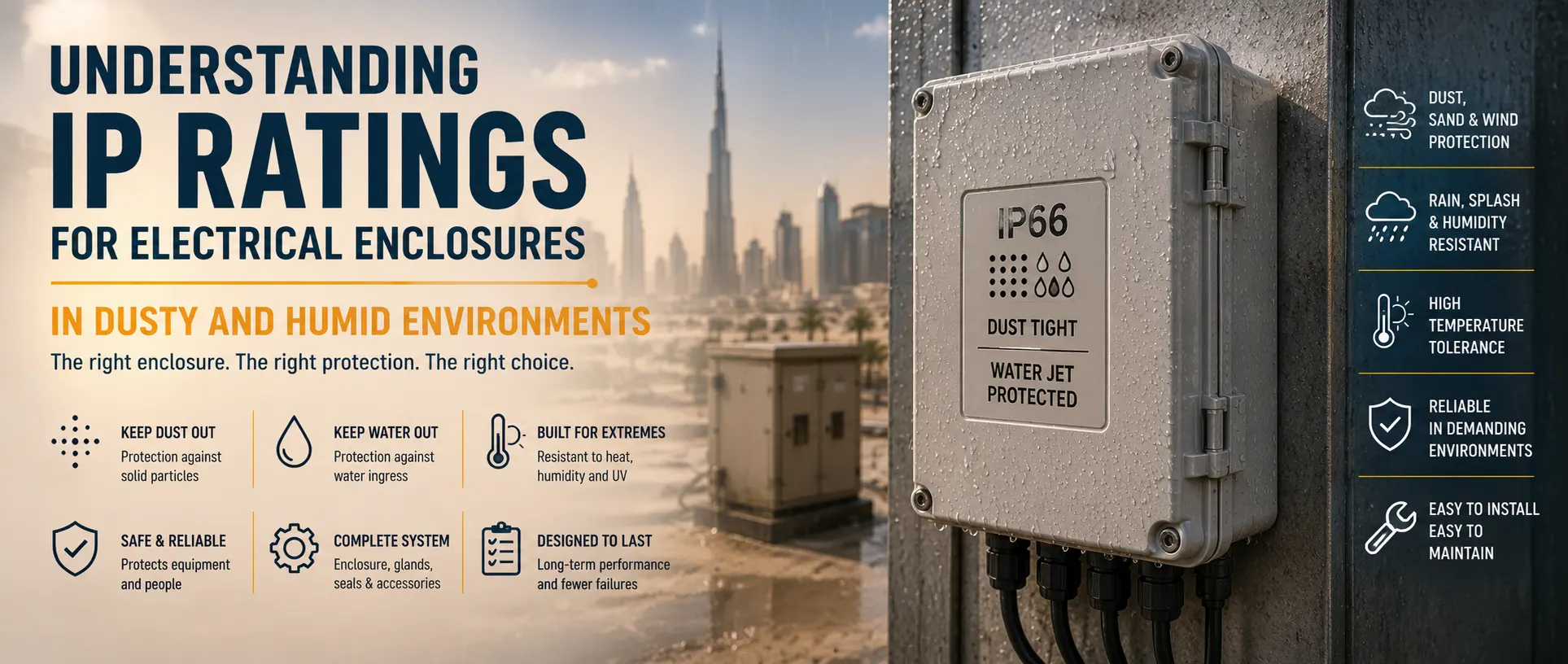
Understanding IP Ratings for Electrical Enclosures in Dusty and Humid Environments
Electrical equipment rarely operates in perfect conditions. Dust, moisture, humidity, water spray and accidental contact can all affect the reliability of electrical components. In industrial facilities, outdoor installations, construction sites and utility infrastructure, selecting an appropriate enclosure can therefore be just as important as selecting the equipment inside it.
This is where IP ratings, or Ingress Protection ratings, become useful.
An IP rating provides a standardised way of describing how effectively an enclosure protects its contents against the entry of solid foreign objects and water. Understanding the rating can help engineers, contractors and facility managers select electrical enclosures that are appropriate for the actual installation environment.
However, an IP rating should not be treated as a simple "higher is always better" number. The correct rating depends on where the enclosure will be installed, what type of exposure it will experience and what level of protection the equipment actually requires.
What Does an IP Rating Mean?
IP stands for Ingress Protection.
The rating normally consists of two digits, such as:
IP54
The first digit relates primarily to protection against solid foreign objects, including dust and accidental access to hazardous parts.
The second digit relates to protection against water.
The two digits therefore answer two different questions:
How well does the enclosure protect against solids?
How well does it protect against water?
For example, an enclosure rated IP65 has a different protection profile from an enclosure rated IP54, even though both provide protection against environmental exposure.
Understanding the individual digits is more useful than simply memorising the ratings.
Understanding the First IP Digit
The first digit indicates the enclosure's protection against solid objects and access to hazardous parts.
The commonly used levels range from 0 to 6.
A rating of 0 means there is no specified protection against solid ingress.
As the number increases, the level of protection improves.
A rating of IP5X indicates that the enclosure is dust-protected, while IP6X represents a higher level of protection and is associated with a dust-tight enclosure.
This distinction matters in dusty environments.
An electrical cabinet installed in an indoor office may not require the same solid-particle protection as a control panel installed in a cement plant, workshop, quarry or outdoor utility installation.
Dust can enter through small openings and accumulate around electrical components. Over time, this can interfere with cooling, insulation performance, connectors and moving components.
Understanding the Second IP Digit
The second digit describes protection against water.
Different ratings address different forms of water exposure, ranging from dripping water to water jets and temporary immersion.
For example, the protection requirements for an enclosure installed inside a dry electrical room are very different from those for an outdoor enclosure exposed to rain.
Some common examples include:
IPX1: Protection against vertically falling water drops
IPX4: Protection against water splashing from different directions
IPX5: Protection against water jets
IPX6: Protection against powerful water jets
IPX7: Protection against temporary immersion
IPX8: Protection against continuous or extended immersion under specified conditions
The exact test conditions are important, so the rating should always be interpreted according to the relevant standard and manufacturer's documentation.
Dusty Environments Need More Than a High IP Number
Dust protection is particularly important in industrial environments.
Facilities such as:
Cement plants
Quarries
Warehouses
Manufacturing facilities
Workshops
Construction sites
Mining-related installations
Agricultural processing facilities
can expose electrical equipment to significant amounts of airborne particles.
Fine dust can enter equipment through ventilation openings, cable entries and poorly sealed joints.
An enclosure rated IP6X provides a stronger dust-ingress barrier than an IP5X enclosure, but enclosure selection still needs to consider how the equipment manages heat.
A completely sealed enclosure can reduce natural airflow. If the internal equipment produces significant heat, the designer may need to consider heat exchangers, cooling systems or other thermal-management methods.
In other words, improving ingress protection can create a thermal-design challenge.
Humidity Is Not the Same as Water Ingress
One common misunderstanding is that an enclosure with a high IP water rating automatically solves every humidity problem.
It does not.
Humidity can create problems even when liquid water is not directly entering the enclosure.
Temperature changes can cause condensation inside an enclosure. For example, an enclosure may cool significantly overnight after operating during a warm day.
If the internal air contains moisture, that temperature change can cause condensation on internal surfaces or electrical components.
This can contribute to:
Corrosion
Insulation degradation
Contact resistance
Circuit-board problems
Tracking
Intermittent faults
Therefore, equipment installed in humid environments may require additional measures such as enclosure heaters, anti-condensation devices, suitable ventilation strategies or environmental controls.
Cable Glands Are Part of the Protection System
An enclosure can have an excellent IP rating, but the installation can still become vulnerable through cable entry points.
Cable glands, plugs and connectors must be selected and installed appropriately.
Poorly installed cable entries can create openings that allow:
Dust
Moisture
Water
Insects
Other contaminants
to enter the enclosure.
The cable gland should therefore be compatible with the cable type, enclosure and environmental conditions.
Unused cable entries should also be properly sealed rather than left open.
This is a simple installation detail that can have a major effect on the practical performance of the complete enclosure assembly.
IP Ratings and Outdoor Electrical Equipment
Outdoor installations present multiple environmental challenges.
An enclosure may be exposed to:
Rain
Wind-driven dust
Direct sunlight
Temperature cycling
Humidity
Condensation
Cleaning water
Accidental water spray
Selecting an IP rating should therefore begin with understanding the actual exposure.
For example, an enclosure installed under a sheltered roof may experience less direct rain than one mounted on an exposed rooftop.
However, sheltered locations can still experience dust and humidity.
The IP rating should be selected according to the actual installation environment rather than simply choosing the highest available rating.
IP Rating Does Not Cover Everything
An important point is that an IP rating describes ingress protection. It does not automatically tell you whether an enclosure is suitable for every environmental condition.
IP testing does not by itself fully address issues such as:
UV exposure
Corrosive chemicals
Salt-laden environments
Mechanical impact
Extreme temperature
Fire
Explosion hazards
Electromagnetic compatibility
For example, an enclosure installed near a coastal environment may need corrosion-resistant materials or coatings even if its IP rating is appropriate for water exposure.
Similarly, an industrial area containing corrosive chemicals may require a material specifically selected for chemical resistance.
IP Rating Versus NEMA Ratings
Engineers working on international projects may encounter both IP and NEMA enclosure classifications.
They are not simply interchangeable labels.
IP ratings specifically describe ingress protection characteristics according to the applicable international standard.
NEMA enclosure classifications consider broader enclosure characteristics and environmental protection requirements.
If a project specification calls for a particular NEMA classification, it should not automatically be replaced with an assumed equivalent IP rating without checking the actual requirements.
The correct approach is to compare the relevant standards and verify that the proposed enclosure meets the project's specified performance criteria.
Choosing the Right IP Rating
A practical selection process can be built around a few questions.
1. Where will the enclosure be installed?
Indoor, outdoor, rooftop, underground, industrial or utility locations can have very different environmental conditions.
2. What type of solid contamination is expected?
Consider ordinary dust, fine industrial dust, fibres, dirt and other particles.
3. What type of water exposure is possible?
Will the enclosure encounter condensation, rain, splashing, cleaning water or high-pressure water jets?
4. Is humidity a concern?
If the site experiences significant temperature changes or high humidity, condensation control may be necessary.
5. Are other environmental hazards present?
Consider UV radiation, corrosion, chemicals, impact and extreme temperatures.
6. How will heat be removed?
A sealed enclosure can trap heat. The thermal design must therefore be checked alongside the IP requirement.
Common IP-Rating Mistakes
Several mistakes can reduce the effectiveness of an otherwise well-selected enclosure.
Choosing the highest IP rating without checking thermal requirements: A highly sealed enclosure may require additional cooling.
Ignoring cable entries: Poorly installed glands can compromise the enclosure's practical protection.
Confusing humidity with water ingress: Condensation can occur even when liquid water does not enter the enclosure.
Assuming IP covers corrosion: IP protection does not automatically provide chemical or corrosion resistance.
Treating IP ratings as permanent guarantees: Damaged seals, ageing gaskets and incorrect maintenance can reduce the enclosure's protection over time.
Maintenance Still Matters
An enclosure's IP performance depends heavily on its physical condition.
Gaskets can age. Cable glands can loosen. Doors can become misaligned. Unused openings can be left unsealed after maintenance work.
Regular inspection should therefore include:
Door and gasket condition
Cable glands
Sealing plugs
Enclosure damage
Corrosion
Drainage arrangements
Signs of condensation
Dust accumulation
A well-rated enclosure that is poorly maintained may provide less protection than expected.
Conclusion
IP ratings provide a useful and standardised way to evaluate the ingress protection offered by electrical enclosures.
For dusty and humid environments, however, choosing the correct rating requires more than looking for the biggest number.
The first IP digit addresses protection against solid ingress, while the second addresses water ingress. Engineers must then consider the actual installation environment, cable entries, condensation, thermal management, corrosion, UV exposure and maintenance requirements.
The most suitable enclosure is therefore not necessarily the one with the highest IP rating. It is the one that provides appropriate protection for the environment while allowing the enclosed equipment to operate safely and reliably.
For industrial and outdoor electrical installations, getting this decision right at the design stage can help reduce contamination-related failures, minimise maintenance problems and extend the service life of critical electrical equipment.
Frequently Asked Questions
1. What does IP65 mean for an electrical enclosure?
IP65 indicates a high level of protection against solid ingress, including dust, together with protection against water jets from applicable directions. It is commonly considered for outdoor and industrial applications, but the complete installation conditions must still be evaluated.
2. Is IP66 better than IP65?
IP66 provides a higher level of water-jet protection than IP65. However, "better" depends on the application. If the enclosure does not face powerful water jets, selecting IP66 may provide little practical advantage compared with an appropriately rated enclosure.
3. Does a high IP rating protect equipment from humidity?
Not necessarily. IP ratings address ingress protection under specified test conditions. Humidity and condensation inside an enclosure can still create problems, so anti-condensation measures may be required in humid environments.
4. Can cable glands affect the IP rating?
Yes. Cable entries are an important part of the enclosure system. Incorrectly selected, damaged or poorly installed cable glands can allow dust or moisture to enter and compromise the intended level of protection.
5. Is IP rating enough for an outdoor electrical installation?
No. IP rating is only one consideration. Outdoor installations may also require protection against UV radiation, corrosion, temperature extremes, mechanical impact, chemicals and other site-specific hazards.
