
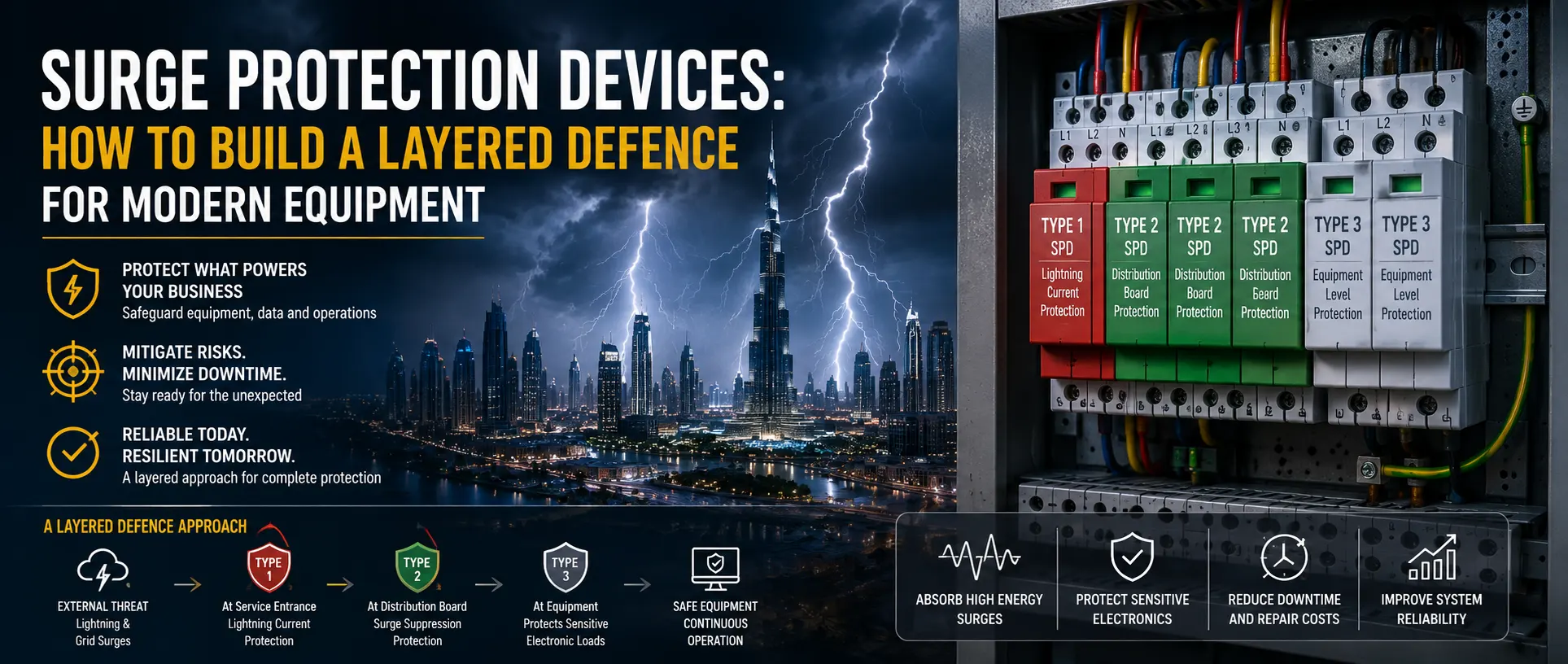
Surge Protection Devices: How to Build a Layered Defence for Modern Equipment
Modern buildings depend on increasingly sensitive electrical and electronic equipment. Computers, networking systems, CCTV, access-control systems, building-management systems, industrial controllers and telecom equipment can all be affected by electrical surges.
A surge may last only a very short time, but its effect can be significant. It can damage electronic components, interrupt operations or gradually weaken equipment until a later failure occurs.
This is why surge protection should not be treated as a single-device decision.
A reliable electrical installation uses a layered approach, with surge protection devices (SPDs) positioned according to the characteristics of the electrical system, incoming exposure and sensitivity of the connected equipment.
For modern commercial, industrial and infrastructure projects, the objective is not simply to install an SPD. It is to create a coordinated protection strategy that reduces the energy reaching sensitive equipment.
What Is an Electrical Surge?
An electrical surge is a temporary increase in voltage that can exceed the normal operating voltage of an electrical system.
Surges can originate from several sources.
One of the most obvious is lightning. A direct or nearby lightning event can introduce extremely high transient energy into electrical and communication systems.
However, not every surge is caused by lightning.
Electrical switching can also create transient overvoltages. Large motors, transformers, capacitors and other inductive or switching loads can generate disturbances when they are switched on or off.
Common sources include:
Lightning activity
Utility switching
Transformer switching
Motor starting and stopping
Capacitor-bank switching
Fault conditions
Switching operations within industrial facilities
Even when a building has never experienced a direct lightning strike, its electrical equipment can still be exposed to transient events.
Why One SPD Is Often Not Enough
A common approach is to install one surge protection device at the main distribution board and assume that the entire building is protected.
That can be insufficient.
A surge can travel through electrical wiring and reach downstream distribution boards and sensitive loads. Different parts of a building may also have different exposure levels.
A better strategy is to divide the electrical installation into protection zones.
For example:
Incoming supply ? Main distribution ? Sub-distribution ? Sensitive equipment
An SPD can be selected at appropriate points along this path.
The upstream device handles higher-energy surge events, while downstream protection helps limit the residual transient reaching sensitive equipment.
This is the basic idea behind coordinated or layered surge protection.
The First Layer: Main Incoming Protection
The first level of protection is normally associated with the incoming electrical supply.
Its role is to handle high-energy surge conditions before they propagate deeper into the installation.
This protection is particularly important where the building or installation has significant exposure to lightning or where external electrical networks can introduce transient disturbances.
The exact SPD arrangement depends on the electrical system, earthing configuration, installation characteristics and applicable design requirements.
The main SPD should therefore be selected as part of the complete electrical protection system rather than as an isolated product.
The Second Layer: Distribution Board Protection
Even after the incoming surge has been reduced, residual transient energy may remain.
Additional protection can therefore be installed at downstream distribution boards.
This creates another barrier between the incoming electrical system and sensitive loads.
For larger buildings, multiple distribution levels may exist.
For example:
Main LV panel ? Floor DB ? Local DB ? Equipment
Each stage may require consideration of the surge environment and the coordination between SPDs.
The objective is to progressively reduce the transient voltage as it moves toward sensitive equipment.
The Final Layer: Protection Near Sensitive Equipment
Some equipment is particularly sensitive to transient overvoltage.
Examples include:
Servers
Network switches
CCTV systems
Fire and security systems
Building automation controllers
PLCs
Medical electronics
Telecom equipment
Audio-visual systems
For these loads, protection closer to the equipment may provide an additional layer of defence.
This is especially useful where cable runs between the distribution board and equipment are relatively long or where the equipment has a low tolerance for transient disturbances.
Surge Protection Is Not Only About Power Cables
One of the most common mistakes is protecting the AC power supply while ignoring other conductive paths.
Modern equipment may be connected to multiple external systems.
For example, a CCTV camera may have:
AC or DC power
Ethernet
Data communication
External signal connections
A telecom system may have:
AC power
DC power
Ethernet
Coaxial cables
Antenna connections
External communication lines
A surge can enter through any suitable conductive path.
Therefore, a complete protection strategy may need to consider:
AC power lines
DC power systems
Ethernet and data lines
Coaxial communication lines
Telephone or signal circuits
External antenna connections
Protecting only one path can leave the equipment vulnerable through another.
Understanding SPD Types
SPDs are commonly categorised according to their intended location and ability to handle different surge conditions.
Type 1 SPDs are generally associated with the service entrance and installations where high-energy surge currents, including lightning-related currents, need to be considered.
Type 2 SPDs are commonly used at distribution boards to protect against transient overvoltages that can occur within the electrical installation or remain after upstream protection.
Type 3 SPDs are generally installed closer to sensitive loads and provide a final level of protection.
These categories should not be interpreted as three completely independent products that can be selected without considering the system.
The correct arrangement depends on the installation design, exposure and coordination between devices.
Coordination Between SPDs Matters
Installing multiple SPDs does not automatically create a good protection system.
The devices must be appropriately coordinated.
If protection devices are not properly selected and coordinated, they may not share the surge energy as intended.
Important factors include:
SPD discharge characteristics
Protection level
Short-circuit withstand
Upstream protection
Wiring configuration
Connection length
Manufacturer requirements
Distance between protection stages
The connection between the SPD and the electrical conductors should also be kept appropriately short and arranged according to the manufacturer's installation requirements.
Long connection conductors can add inductive effects during fast transient events and reduce the effectiveness of the protection.
Earthing and Bonding Are Critical
An SPD cannot operate effectively in isolation.
It needs a suitable path to divert surge energy.
This makes earthing and bonding fundamental parts of surge protection.
A building may have high-quality SPDs, but if the earthing and bonding arrangements are poor, the protection performance can be compromised.
The electrical installation should therefore have an appropriately designed earthing and bonding system.
Metallic services, equipment enclosures, cable containment and other conductive systems may also need to be considered as part of the overall bonding strategy.
Selecting the Right Protection Level
The SPD's protection level should be appropriate for the equipment being protected.
Sensitive electronic equipment generally benefits from lower residual voltage exposure.
However, selecting a device with an attractive protection figure is not enough.
The designer must also verify:
System voltage
Number of phases
Earthing arrangement
Maximum continuous operating voltage
Surge current capability
Protection level
Short-circuit rating
Backup overcurrent protection
Expected environmental conditions
The SPD must be compatible with the electrical system in which it will be installed.
Indication and Maintenance
SPDs are protective components and can degrade after repeated surge events.
Many modern devices provide visual status indication to show whether the protection element remains operational.
Some systems can also provide remote alarm contacts for integration with building-management or monitoring systems.
This can be valuable in critical facilities where a failed SPD should not remain unnoticed.
Routine inspection should include:
SPD status indicators
Connections
Backup protective devices
Signs of overheating
Physical damage
Wiring condition
Earthing and bonding connections
A protection system is only useful when its protective devices remain operational.
Common Surge Protection Mistakes
Installing only one SPD
A single device may not provide sufficient protection for an entire complex installation.
Ignoring communication cables
Surges can enter equipment through data and signal connections.
Using long SPD connection wires
Poor installation practices can reduce the effectiveness of an otherwise suitable SPD.
Ignoring earthing
The SPD needs an effective path for surge energy.
Selecting purely by surge-current rating
A high discharge-current number does not automatically mean the SPD is suitable for every application.
Forgetting maintenance
An SPD that has reached the end of its service life may no longer provide the intended protection.
Building a Layered Defence
A practical surge-protection strategy can be visualised as multiple defensive layers:
Layer 1: Protection at the incoming electrical supply
Layer 2: Protection at major distribution boards
Layer 3: Protection at downstream or local panels
Layer 4: Protection close to sensitive equipment
Layer 5: Protection for external data, communication and signal connections
These layers work together with:
Proper earthing
Equipotential bonding
Correct cable routing
Appropriate overcurrent protection
Good installation practices
Regular inspection
The result is a system that does not rely on a single component to absorb every possible transient.
Conclusion
Surge protection for modern electrical installations should be approached as a coordinated system rather than a single-product purchase.
The increasing use of sensitive electronic equipment means that transient overvoltages can have consequences far beyond a simple electrical fault. A surge can interrupt communications, damage controllers, affect security systems or cause expensive downtime.
A layered SPD strategy provides multiple levels of defence. Main incoming protection can address higher-energy events, distribution-level SPDs can provide additional control, and point-of-use protection can help protect sensitive equipment.
However, SPDs are only one part of the solution. Proper earthing, bonding, wiring, coordination and maintenance are equally important.
The best surge-protection system is therefore not simply the one with the highest-rated device. It is the one designed around the building's electrical architecture, environmental exposure and equipment sensitivity.
Frequently Asked Questions
1. Is one surge protection device enough for an entire building?
Usually, relying on a single SPD is not the best approach for a complex building. Multiple protection stages may be appropriate depending on the electrical distribution system, incoming exposure, cable lengths and sensitivity of downstream equipment.
2. What is the difference between Type 1, Type 2 and Type 3 SPDs?
Type 1 devices are generally associated with the incoming supply and higher-energy surge conditions. Type 2 devices are commonly installed at distribution boards, while Type 3 devices are generally used closer to sensitive equipment. The devices should be selected and coordinated according to the actual installation.
3. Can an SPD protect equipment from lightning?
SPDs can help limit transient overvoltages associated with lightning and other surge events, but they should not be considered an absolute guarantee against all lightning damage. A complete lightning and surge protection strategy may require additional measures depending on the building and installation.
4. Do Ethernet and communication cables also need surge protection?
They may. If a cable leaves the protected building zone or connects to externally exposed equipment, it can provide another path for transient energy. Appropriate protection should therefore be considered for data, communication, coaxial and other external signal connections where applicable.
5. How often should surge protection devices be checked?
SPDs should be inspected as part of the electrical installation's maintenance programme. Status indicators, connections, backup protection, physical condition and signs of overheating should be checked. Critical installations may also benefit from remote status monitoring.
