
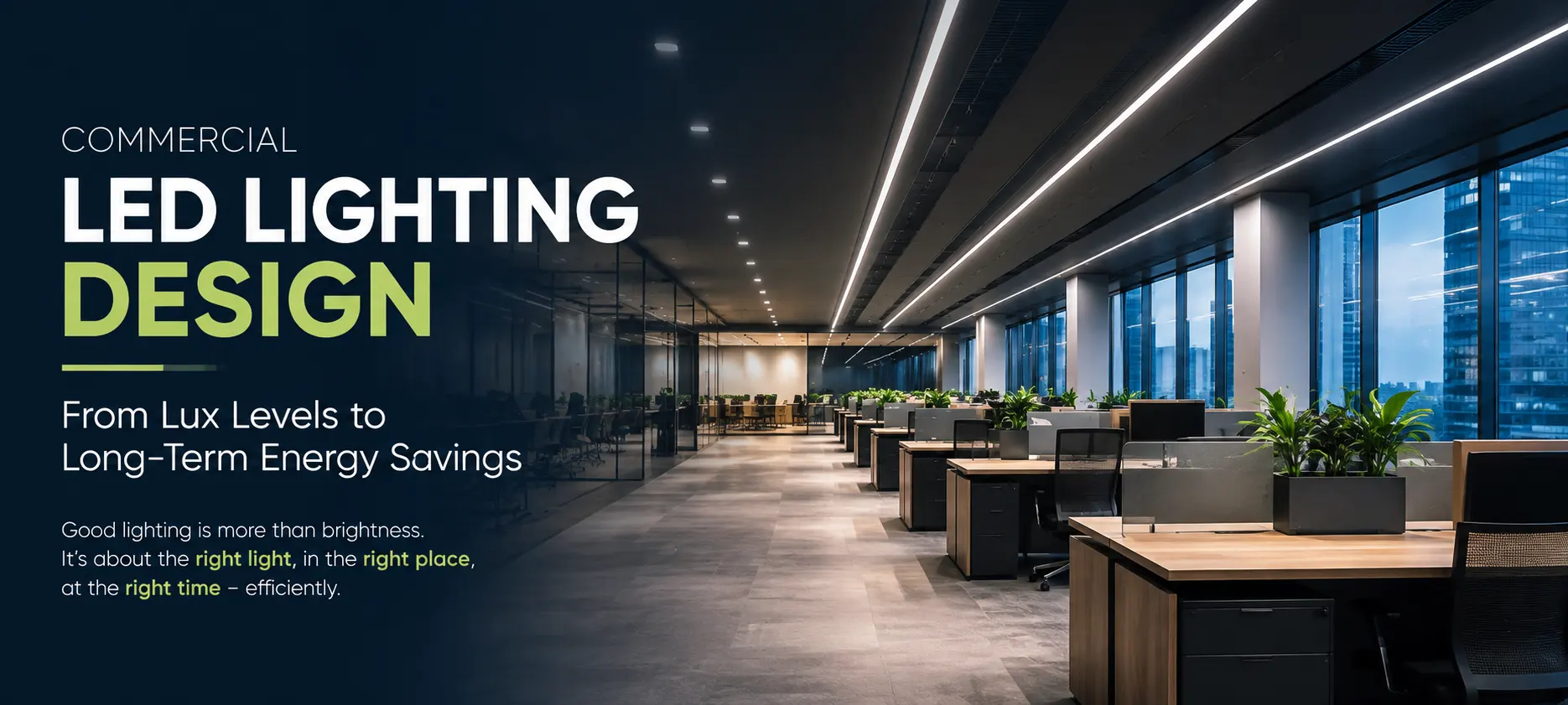
Commercial LED Lighting Design: From Lux Levels to Long-Term Energy Savings
Commercial lighting is no longer simply about installing enough fixtures to make a building look bright. A well-designed lighting system must provide the right amount of illumination, distribute light effectively, minimise glare, support occupant comfort and control energy consumption over many years.
LED technology has transformed commercial lighting because modern LED luminaires can deliver high efficiency, long operating life and flexible control options. However, simply replacing conventional lamps with LED fixtures does not automatically create a good lighting design.
The real objective is to design the system around the space, the activities taking place within it and the required lighting performance.
For commercial projects, this means starting with lux levels, then considering luminaire selection, spacing, uniformity, glare, controls and long-term operating costs.
What Is Lux and Why Does It Matter?
Lux is the unit used to describe illuminance—the amount of light reaching a surface.
In simple terms, lux helps answer the question:
"Is there enough useful light where people actually need it?"
Different spaces have different lighting requirements.
An office desk, warehouse aisle, corridor, reception area and detailed inspection workstation do not require the same lighting conditions.
A common mistake is to judge lighting by how bright the ceiling or light fixture appears. What matters is the illumination delivered to the relevant working surface.
For example, a brightly glowing luminaire does not necessarily mean that a desk underneath it is receiving the appropriate illumination.
Start With the Purpose of the Space
Before selecting LED fixtures, the lighting designer should understand how the space will be used.
Important questions include:
What activities take place there?
Where are the work surfaces?
Are people reading, writing or using computers?
Is detailed visual work involved?
Are there safety-critical activities?
Does the space require continuous operation?
Is daylight available?
Will furniture or equipment layouts change?
A warehouse, for example, may need good vertical illumination so workers can read labels on storage racks.
An office may need comfortable, relatively uniform lighting across workstations while controlling glare on computer screens.
A retail environment may intentionally use accent lighting to draw attention to products.
The lighting design should therefore begin with the application rather than the fixture catalogue.
Understanding Recommended Lux Levels
Lighting requirements vary according to the type of space, task and applicable project standards.
Typical design considerations may include:
Offices
Corridors
Meeting rooms
Reception areas
Retail spaces
Warehouses
Workshops
Parking areas
Staircases
Plant rooms
The exact target illuminance should be established using the applicable lighting standard, project specification and local requirements.
It is important not to treat one lux value as suitable for every commercial area.
More light is not automatically better. Excessive illumination can increase energy consumption and create glare without providing meaningful improvement in visual performance.
Uniformity Is Just as Important
Average lux levels do not tell the entire story.
Imagine a room where some areas receive very high illumination while other areas are significantly darker. The calculated average could look acceptable, but occupants may still experience an uncomfortable or poorly lit environment.
This is why lighting design also considers uniformity.
A well-designed system aims to avoid excessive differences between adjacent areas, particularly in spaces where people work or move continuously.
Uniform lighting can improve visual comfort and reduce areas of unnecessary darkness.
Luminaire spacing, mounting height, beam distribution and room geometry all influence uniformity.
Luminaire Selection Matters
Not all LED fixtures are designed for the same application.
Commercial lighting projects may use:
LED panels
Linear luminaires
Downlights
High-bay fixtures
Low-bay fixtures
Floodlights
Track lighting
Wall-mounted luminaires
Bollards
Emergency lighting
The correct choice depends on mounting height, ceiling type, room dimensions, required light distribution and environmental conditions.
For example, a high-bay warehouse fixture is designed for a very different application from a recessed office panel.
Selecting fixtures based purely on wattage can therefore produce poor results.
Don't Judge Lighting by Wattage Alone
Traditional lighting decisions often focused heavily on lamp wattage.
With LED technology, this approach is less useful.
A 40 W LED luminaire and another 40 W LED luminaire may produce different amounts of useful light because their optical efficiency, LED performance and light distribution can differ.
Important specifications include:
Luminaire power
Delivered lumens
Luminaire efficacy
Colour temperature
Colour rendering
Beam distribution
Glare characteristics
Rated life
Driver performance
The designer should focus on the amount and quality of useful light delivered to the space rather than simply selecting the lowest wattage fixture.
Colour Temperature and Colour Rendering
Lighting quality is not only about quantity.
Colour temperature influences the visual appearance and atmosphere of a space.
Commercial environments commonly use neutral or cool white lighting depending on the application and design intent.
Colour rendering describes how accurately a light source reveals colours compared with a reference source.
This can be important in:
Retail environments
Showrooms
Healthcare-related areas
Design studios
Food-related applications
Inspection areas
The appropriate colour characteristics should therefore be selected according to the activity and visual requirements.
Glare Can Ruin a Good Lighting Design
A room can meet its target lux level and still be uncomfortable if glare is poorly controlled.
Glare can be particularly noticeable in offices where employees work with computer screens.
Potential causes include:
Excessively bright luminaires
Poor luminaire positioning
Direct viewing of LED sources
Reflections from screens
Incorrect beam angles
Highly reflective surfaces
Good lighting design considers glare alongside illumination.
Diffusers, optical designs, suitable mounting positions and appropriate fixture selection can help create a more comfortable environment.
Daylight and Lighting Controls
Commercial buildings often receive significant daylight.
A lighting system that operates at full power throughout the day may waste energy when natural light is already sufficient.
Modern LED systems can therefore be combined with controls such as:
Occupancy sensors
Motion sensors
Daylight sensors
Dimming systems
Timers
Building-management systems
Central lighting-control platforms
For example, lights in a meeting room can automatically reduce or switch off when the room is unoccupied.
Similarly, perimeter lighting near windows can be dimmed when daylight provides sufficient illumination.
Energy Savings Go Beyond LED Replacement
Replacing fluorescent or conventional lamps with LED fixtures can reduce electrical consumption, but the biggest opportunity often comes from combining efficient luminaires with intelligent controls.
Consider a commercial building where lights previously operated at full output for 12 hours every day.
If efficient LED fixtures reduce installed lighting power and occupancy controls reduce operating hours, the combined energy saving can be considerably greater than simply changing the light source.
The calculation should therefore consider both:
Lighting efficiency + operating behaviour
This is where good lighting design becomes an energy-management strategy.
Calculate the Long-Term Cost
The cheapest fixture is not necessarily the cheapest lighting solution.
A commercial lighting evaluation should consider the total cost over the expected operating period.
Factors include:
Purchase price
Installation cost
Electrical consumption
Maintenance
Driver replacement
Cleaning
Expected operating hours
Control-system costs
Expected service life
A higher-quality luminaire may cost more initially but deliver better efficiency, reliability and maintenance performance.
For large commercial buildings operating thousands of hours per year, even a modest efficiency difference can accumulate into meaningful energy savings.
Consider Maintenance and LED Lifetime
LED lighting is often promoted as maintenance-free, but this is not literally true.
LED luminaires contain drivers, thermal-management components and other electronics.
Performance can also change over time due to lumen depreciation.
The design should therefore consider:
Rated lifetime
Lumen maintenance
Driver quality
Operating temperature
Accessibility
Cleaning requirements
Replacement strategy
Fixtures installed in high ceilings or difficult-to-access locations deserve particular attention because maintenance can be expensive.
Lighting Design for UAE Commercial Buildings
Commercial buildings in the UAE often operate for long periods and may have significant cooling loads.
Lighting efficiency can therefore contribute indirectly to overall building energy performance because electrical lighting also produces heat that must eventually be removed by the cooling system.
This makes efficient lighting particularly valuable in air-conditioned commercial spaces.
However, lighting fixtures must also be suitable for the environmental conditions in which they are installed.
For outdoor, parking or semi-exposed areas, designers should consider:
Ambient temperature
Dust
Humidity
Water exposure
UV exposure
Enclosure protection
Corrosion resistance
The luminaire should be selected for the actual environment rather than simply its electrical rating.
A Practical Commercial Lighting Design Process
A sensible workflow can be:
Step 1: Understand the space
Determine dimensions, ceiling height, room use and working areas.
Step 2: Establish the required lighting level
Use the applicable project requirements and lighting standards.
Step 3: Select suitable luminaires
Consider lumen output, distribution, efficacy, glare and environmental suitability.
Step 4: Model fixture positions
Evaluate spacing, mounting height and uniformity.
Step 5: Check lighting quality
Review glare, colour characteristics and visual comfort.
Step 6: Add controls
Consider occupancy detection, daylight harvesting and scheduled operation.
Step 7: Calculate energy consumption
Compare installed lighting power and expected operating hours.
Step 8: Evaluate lifecycle cost
Include energy, maintenance and replacement considerations.
Common Commercial LED Lighting Mistakes
Selecting fixtures by wattage alone: Low wattage does not guarantee adequate or efficient illumination.
Ignoring uniformity: A good average lux value can hide poorly illuminated areas.
Over-lighting the space: Excessive lux can increase energy consumption without improving the working environment.
Ignoring glare: Bright LED sources can create uncomfortable visual conditions.
Leaving controls out of the design: Efficient fixtures can still waste energy if they operate unnecessarily.
Ignoring maintenance: Difficult-to-access fixtures can create significant future costs.
Conclusion
Commercial LED lighting design should be approached as a combination of visual performance, energy efficiency, occupant comfort and lifecycle economics.
Lux levels provide an important starting point, but they are only one part of the design. Uniformity, glare, colour quality, luminaire distribution, controls and maintenance all influence the final result.
LED technology provides an excellent opportunity to reduce energy consumption, but the best results come when efficient luminaires are combined with appropriate lighting levels and intelligent control strategies.
For commercial buildings, especially those operating for long hours, a well-designed LED system can deliver benefits far beyond lower electricity bills. It can improve visual comfort, reduce maintenance requirements, support building energy objectives and provide a more flexible lighting environment.
The goal is therefore not simply to install more efficient lights. It is to design a lighting system that provides the right light, in the right place, at the right time, with the least practical energy consumption.
Frequently Asked Questions
1. What lux level is suitable for a commercial office?
There is no single lux level suitable for every office. The appropriate target depends on the type of work, workplane, applicable lighting standards and project requirements. General office work typically requires a different design approach from detailed visual or specialist tasks.
2. Is a higher lux level always better?
No. Excessive illumination can increase energy consumption and may contribute to glare. The objective is to provide an appropriate level of illumination with good uniformity and visual comfort.
3. How can LED lighting reduce commercial building energy consumption?
LED luminaires can provide more useful light for less electrical power than many older lighting technologies. Additional savings can come from occupancy sensors, daylight controls, dimming and scheduled operation.
4. What is more important: lumens or watts?
Both are relevant, but they describe different things. Watts indicate electrical power consumption, while lumens indicate light output. A good lighting design considers delivered lumens, luminaire efficacy, distribution and the actual illumination achieved in the space.
5. Do commercial LED lights require maintenance?
Yes. Although LEDs generally have long service lives, luminaires still contain drivers and electronic components and can experience lumen depreciation. Regular inspection, cleaning and planned replacement are particularly important for fixtures installed in difficult-to-access locations.
