
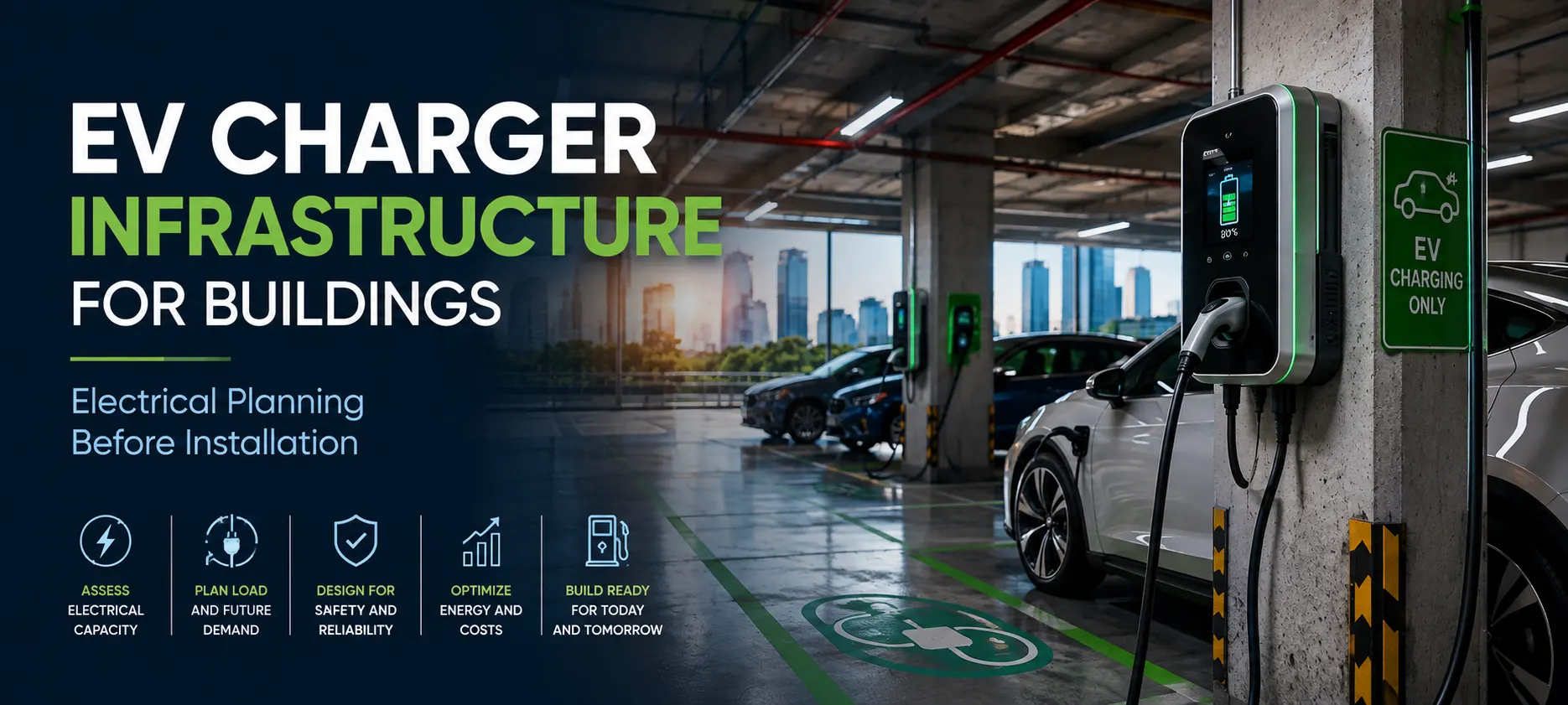
EV Charger Infrastructure for Buildings: Electrical Planning Before Installation
Electric vehicle charging is becoming an important part of modern building infrastructure. Offices, residential developments, retail centres, hotels, warehouses and commercial facilities are increasingly expected to provide convenient charging for EV users.
However, installing an EV charger is not simply a matter of mounting a charging unit on a wall and connecting it to the nearest distribution board.
EV chargers can introduce significant continuous electrical loads. When several chargers operate at the same time, the resulting demand can place substantial pressure on the building's electrical infrastructure.
This makes electrical planning one of the most important stages of an EV charging project.
A successful installation should consider available electrical capacity, charger ratings, cable sizing, protection, load management, parking layout, future expansion and the building's existing electrical system before any equipment is purchased.
Start With the Building's Existing Electrical Capacity
The first question should not be:
"Which EV charger should we install?"
It should be:
"How much additional electrical load can the building safely support?"
Every building has a limited electrical capacity determined by factors such as:
Utility connection capacity
Main transformer rating
Main switchboard capacity
Existing maximum demand
Distribution-board capacity
Feeder cable capacity
Available spare circuits
Existing HVAC and mechanical loads
Future building expansion
A building may have a large incoming supply but very little spare capacity because most of it is already being used by air-conditioning, lifts, pumps, lighting and other equipment.
This is particularly important for commercial buildings where electrical demand can vary significantly throughout the day.
Determine the EV Charging Requirement
The next step is to understand how many vehicles need charging and how quickly they need to charge.
Not every parking space needs a high-power charger.
For example, an office employee who parks for eight hours may not require the same charging capacity as a customer visiting a retail centre for 30 minutes.
Charging requirements should therefore be based on the actual use case.
Important questions include:
How many EVs are expected?
How long do vehicles typically remain parked?
How much energy does each vehicle need?
Is charging required during working hours?
Are users employees, residents, customers or fleet operators?
Is rapid charging actually necessary?
How many chargers are required initially?
How many may be added later?
Answering these questions can prevent unnecessary investment in oversized electrical infrastructure.
Charger Power Directly Affects Electrical Demand
EV chargers are available in different power levels.
A relatively low-power AC charger may place a modest load on a building, while multiple high-power chargers can create a substantial demand.
For example, installing ten chargers rated at 22 kW each could theoretically create a connected charging load of 220 kW if all chargers operate simultaneously at full output.
That does not necessarily mean the building will always consume 220 kW from the chargers, but the electrical design must consider the possibility and determine how simultaneous demand will be managed.
This is where load management becomes extremely valuable.
Don't Assume Every Charger Will Operate at Full Power
One of the biggest opportunities in EV infrastructure design is intelligent load management.
Instead of allowing every charger to draw maximum power simultaneously, a central system can monitor the building's electrical demand and distribute available capacity between charging points.
For example:
Available capacity ? Building loads + EV charging loads
If the building's HVAC demand increases, the charging system can reduce EV charging power.
When the building load falls, additional charging capacity can become available.
This approach can reduce the need for expensive electrical infrastructure upgrades while still providing useful charging services.
Consider Diversity and Simultaneous Demand
Traditional electrical design often uses demand and diversity considerations because not every connected load operates at maximum power at exactly the same time.
EV charging requires careful consideration of this principle.
A charging facility with 20 connectors does not automatically mean that the electrical system should be designed as if all 20 vehicles will continuously draw their maximum rated power.
However, the assumed charging profile must be realistic and defensible.
Factors such as operating hours, user behaviour, charger controls and expected vehicle occupancy should be considered.
For critical infrastructure, the design should also consider what happens if several vehicles begin charging simultaneously.
Cable Sizing for EV Chargers
EV charging circuits can carry substantial current for long periods.
This makes cable sizing particularly important.
The design should consider:
Charger rated current
Supply voltage
Single-phase or three-phase operation
Cable length
Installation method
Ambient temperature
Cable grouping
Voltage drop
Continuous operating conditions
Short-circuit requirements
A cable that appears adequate based on a simple current calculation may require adjustment once installation conditions and voltage drop are considered.
Long cable runs from a building's electrical room to remote parking areas deserve particular attention.
Undersized cables can result in excessive voltage drop and additional heating.
Voltage Drop Can Become Important
EV chargers may operate for extended periods at substantial load.
If the charger is located far from the distribution board, voltage drop can become a significant design consideration.
This is especially relevant for:
Basement parking
Large outdoor car parks
Multi-level parking structures
Remote parking areas
Fleet charging yards
Increasing conductor size may sometimes be necessary to keep voltage drop within the project's design limits.
The designer should evaluate the complete circuit rather than selecting cable size based solely on the charger's rated current.
Protection Requirements Must Be Planned
EV charging circuits require appropriate electrical protection.
Depending on the charger and installation arrangement, the design may need to consider:
Overcurrent protection
Short-circuit protection
Residual-current protection
Earthing
Surge protection
Isolation
Emergency shutdown arrangements
Charger-specific protection requirements
The exact protection arrangement depends on the charger technology, electrical system and applicable standards.
The protection system should also be coordinated with the upstream distribution equipment.
Simply adding a large breaker to an existing distribution board is not sufficient if the feeder cable, board capacity or upstream protection cannot support the additional load.
Earthing and Electrical Safety
EV chargers are connected to equipment that users interact with directly while handling a vehicle.
Electrical safety therefore deserves particular attention.
The installation should have an appropriate earthing and bonding arrangement and comply with the applicable electrical safety requirements.
The designer should also consider the physical environment.
Parking areas can expose electrical equipment to:
Water
Dust
Vehicle impact
Cleaning operations
Temperature variations
Mechanical damage
The charger enclosure, cable-management system and associated electrical equipment should be suitable for the actual installation environment.
Surge Protection and Power Quality
EV charging equipment contains electronic power-conversion systems.
Like other modern electronic equipment, chargers can be affected by electrical disturbances.
Surge protection should therefore be considered as part of the overall electrical design.
The protection strategy may need to consider:
Incoming electrical supply
Distribution boards
Charger circuits
Communication systems
External charging equipment
The appropriate arrangement depends on the building's electrical architecture and exposure.
Parking Layout Is an Electrical Design Issue Too
The physical location of chargers affects the electrical installation.
Before finalising charger positions, consider:
Distance from distribution boards
Cable routes
Cable containment
Vehicle parking orientation
Pedestrian movement
Accessibility
Vehicle impact protection
Drainage
Lighting
Emergency access
Future charger locations
Poor planning can result in unnecessarily long cable runs and difficult maintenance access.
A charger location that looks convenient from a parking perspective may be expensive to connect electrically.
Plan for Future Expansion
EV adoption is likely to increase over the life of a building.
Installing only today's required charging points may result in expensive modifications later.
Future planning can include:
Spare capacity in distribution boards
Additional feeder capacity
Empty conduits
Spare cable routes
Reserved parking locations
Communication infrastructure
Load-management capability
This does not mean installing every charger immediately.
A better approach can be to install the initial charging equipment while preparing the electrical infrastructure for future expansion.
Solar and Energy Storage Integration
Some buildings may combine EV charging with solar photovoltaic systems or battery energy storage.
This can create additional opportunities for energy management.
For example, charging can be scheduled during periods when solar generation is high.
A building energy-management system can potentially coordinate:
Solar generation + building demand + battery storage + EV charging
The objective is to use available energy intelligently while maintaining the building's operational requirements.
However, the electrical system must be designed carefully to ensure that generation, storage, charging and building loads operate safely together.
EV Chargers and Building Load Management
EV charging should ideally be treated as part of the building's overall electrical ecosystem.
Instead of operating independently, chargers can be integrated into a broader energy-management strategy.
The system can monitor:
Building demand
EV charging demand
Available electrical capacity
Solar generation
Battery state of charge
Charger status
This provides the ability to dynamically adjust charging power.
For larger commercial facilities, this can be much more effective than simply installing increasingly large electrical infrastructure.
A Practical EV Infrastructure Planning Process
Step 1: Assess the existing electrical system
Review transformer, main switchboard, feeders and current demand.
Step 2: Define charging requirements
Determine the number of users, parking duration and required charging speed.
Step 3: Select charger types
Choose suitable AC or DC charging equipment based on the application.
Step 4: Calculate electrical demand
Consider charger power, diversity and simultaneous charging behaviour.
Step 5: Design distribution
Determine feeder cables, distribution boards, protection and containment.
Step 6: Check voltage drop
Evaluate long charging circuits and remote parking locations.
Step 7: Design load management
Determine whether dynamic charging control can reduce peak demand.
Step 8: Plan physical installation
Coordinate charger positions, cable routes, vehicle protection and pedestrian safety.
Step 9: Prepare for expansion
Provide practical infrastructure for future charging points where justified.
Common EV Charging Infrastructure Mistakes
Installing chargers without checking spare electrical capacity: This can overload existing infrastructure.
Sizing cables only by current: Voltage drop, installation conditions and continuous operation also matter.
Installing too many high-power chargers: The building may not need that much charging capacity.
Ignoring load management: Intelligent charging can significantly reduce peak demand.
Forgetting future expansion: Retrofitting conduits and feeders later can be expensive.
Ignoring parking layout: Poor charger positioning can create long cable routes and maintenance problems.
Treating chargers as standalone equipment: EV charging should be integrated with the building's wider electrical and energy strategy.
Conclusion
EV charger installation is fundamentally an electrical infrastructure project.
The charger itself is only one component of the system. Before installation, engineers should assess the building's available electrical capacity, charging demand, cable requirements, voltage drop, protection, earthing, physical layout and future expansion requirements.
For buildings with multiple chargers, load management can be particularly valuable because it allows available electrical capacity to be shared intelligently between the building and EV charging loads.
The most effective EV charging installation is therefore not necessarily the one with the highest charger power or the largest number of charging points.
It is the system that delivers the required charging service while working safely and efficiently within the building's electrical capacity.
Good planning before installation can reduce infrastructure costs, simplify future expansion, improve reliability and prevent expensive electrical upgrades after the chargers are already installed.
Frequently Asked Questions
1. Does installing EV chargers require upgrading the building's electrical supply?
Not always. The answer depends on the building's existing spare capacity and the expected EV charging demand. Load management can sometimes allow chargers to operate within the available capacity without a major supply upgrade.
2. How many EV chargers can a building support?
There is no universal number. It depends on the building's electrical capacity, charger power, expected simultaneous charging demand and load-management strategy. A detailed electrical assessment should be completed before determining the final number.
3. Is a 22 kW charger always better than a lower-power charger?
No. The appropriate charger depends on how long vehicles remain parked and how much energy they need. An office where vehicles remain parked for several hours may not need high-power charging, while a fleet or rapid-turnover location may have different requirements.
4. Why is load management important for multiple EV chargers?
Without load management, several chargers operating simultaneously can create a large electrical demand. A load-management system can distribute available capacity between chargers and reduce charging power when the building's electrical demand increases.
5. Should EV charging infrastructure be designed for future expansion?
Yes, where future EV adoption is reasonably expected. Spare distribution capacity, conduits, cable routes, communication infrastructure and suitable equipment locations can make future expansion significantly easier and less expensive.
