
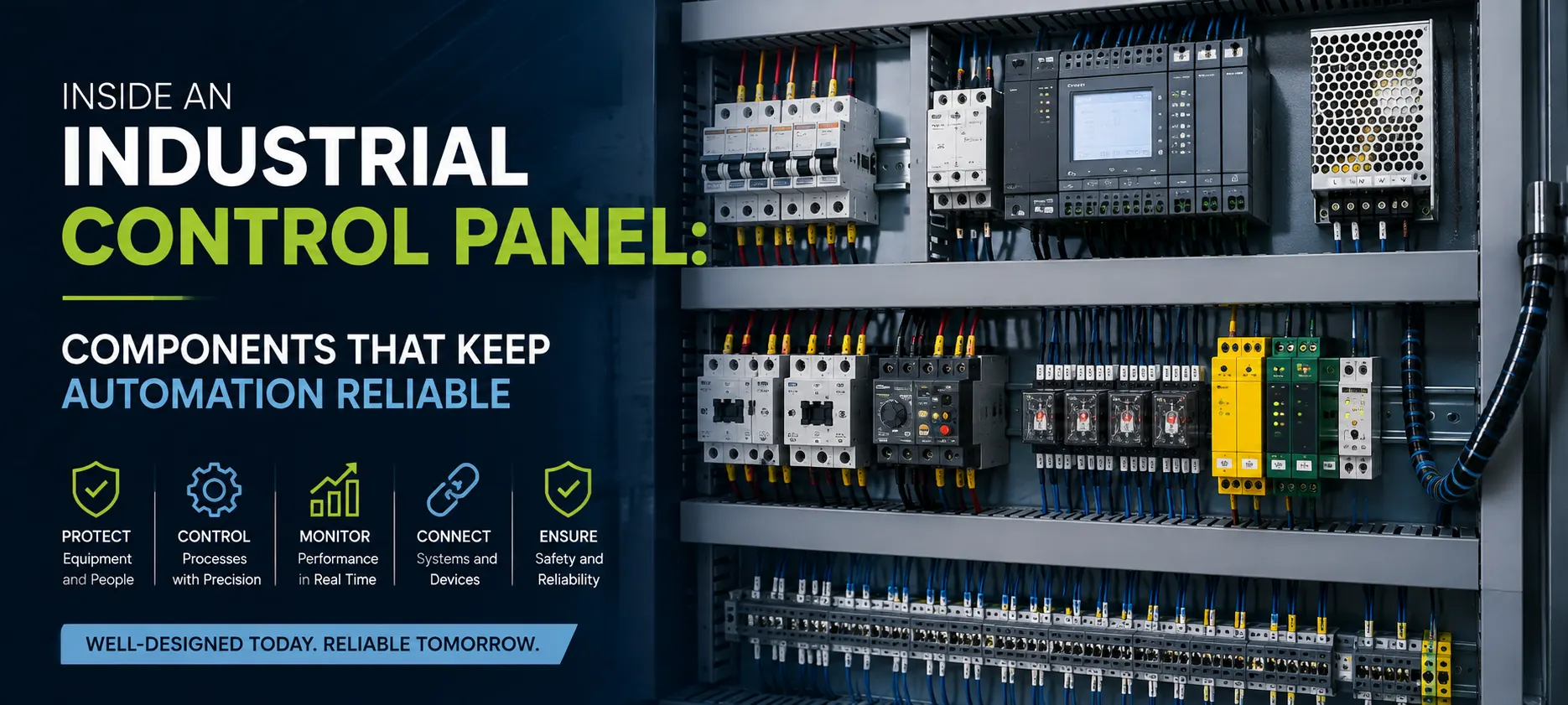
Inside an Industrial Control Panel: Components That Keep Automation Reliable
An industrial control panel may look like a collection of breakers, terminals, relays and electronic devices mounted inside a metal enclosure. But behind that simple appearance is a carefully organised system that distributes power, protects equipment, controls machinery and allows operators and automation systems to monitor what is happening.
A well-designed control panel is therefore much more than an electrical box.
It is the point where power, control, protection, communication and automation come together.
Industrial facilities depend on these panels to keep motors, pumps, conveyors, HVAC systems, production lines and other equipment operating safely. A poorly selected or poorly maintained component can cause nuisance trips, control failures, overheating or unexpected production downtime.
Understanding the main components inside a control panel makes it easier to design, troubleshoot and maintain reliable automation systems.
What Is an Industrial Control Panel?
An industrial control panel is an enclosure containing electrical and electronic equipment used to control and protect machinery or industrial processes.
The exact contents vary depending on the application, but a typical panel may contain:
Main isolator
Circuit breakers
Fuses
Contactors
Overload relays
Power supplies
Programmable logic controllers
Relays
Terminal blocks
Variable frequency drives
Surge protection
Communication equipment
Control transformers
Monitoring devices
The components are normally arranged according to their function, with clear separation between power and control circuits where appropriate.
This organisation is important because it improves safety, reduces electrical interference and makes troubleshooting easier.
The Main Isolator: The First Point of Control
The main isolator provides a means of disconnecting the panel from its incoming electrical supply.
During maintenance, technicians need a reliable way to isolate the panel before working on internal components.
The isolator should therefore be appropriately rated for the system voltage, current and installation conditions.
Depending on the panel design, it may also include provisions for locking or other safety procedures so that the supply remains isolated during maintenance.
A correctly selected isolator is one of the simplest but most important components in the entire panel.
Circuit Breakers and Fuses
Once power enters the control panel, protective devices help protect circuits against faults and excessive current.
Common devices include miniature circuit breakers, moulded-case circuit breakers and fuses, depending on the application.
Their functions can include protection against:
Overcurrent
Short circuits
Equipment faults
Wiring faults
Protection should be coordinated with the cables and connected equipment.
A breaker should not simply be selected because its current rating matches the load. The designer must also consider the cable capacity, prospective fault current, discrimination and the characteristics of the connected equipment.
Good protection allows a fault to be isolated without unnecessarily shutting down unrelated parts of the plant.
Contactors: Switching High-Power Loads
Contactors are commonly used to switch motors and other significant electrical loads.
A contactor allows a relatively small control signal to operate a higher-power circuit.
For example, a PLC or control circuit may energise a contactor coil, causing the contactor's main contacts to connect power to a motor.
This creates a useful separation between the control system and the higher-power load.
Contactors are widely used for:
Motors
Pumps
Fans
Compressors
Heaters
Other industrial loads
The contactor must be selected according to the load type, voltage, current, switching frequency and expected operating duty.
Overload Relays Protect Motors
A contactor switches a motor, but it does not by itself provide complete motor protection.
An overload relay monitors motor current and can disconnect the motor-control circuit if the motor experiences a sustained overload condition.
This helps protect against conditions such as:
Mechanical overload
Excessive operating current
Certain phase-related problems
Prolonged abnormal operation
Correct adjustment is important.
If the overload setting is too high, the motor may not receive adequate protection. If it is too low, nuisance trips may occur during normal operation.
Motor protection should therefore be based on the actual motor characteristics and the overall control-system design.
The PLC: The Brain of the Panel
The Programmable Logic Controller (PLC) is one of the most important components in many modern industrial control panels.
Instead of relying entirely on hard-wired control logic, a PLC can execute programmed instructions based on inputs and operating conditions.
Inputs may come from:
Sensors
Push buttons
Limit switches
Pressure switches
Temperature sensors
Flow devices
Level sensors
The PLC processes these signals and produces outputs that control:
Contactors
Valves
Relays
Motors
Indicators
Drives
Other control equipment
This makes the PLC the logical centre of many automated processes.
Power Supplies Keep Electronics Stable
Industrial control panels often contain electronic equipment that requires a low-voltage DC supply.
A common arrangement is a power supply converting incoming AC power into a controlled DC voltage for:
PLCs
Sensors
Relays
Communication devices
HMI systems
Industrial network equipment
The power supply should be selected according to the total connected load, startup demand and required operating margin.
Where the control system is critical, designers may also consider redundancy or additional protection for the control-power circuit.
A failure of the control power supply can stop an otherwise healthy machine.
Terminal Blocks Make Wiring Manageable
Terminal blocks provide an organised connection point between field wiring and equipment inside the control panel.
Field devices such as sensors, motors and actuators may be located many metres away from the panel.
Instead of connecting every external cable directly to internal equipment, terminal blocks provide a structured interface.
Good terminal-block organisation helps with:
Troubleshooting
Testing
Maintenance
Circuit identification
Future modifications
Cable management
Each terminal should be clearly identified according to the panel's electrical drawings.
Poor labelling can turn a simple troubleshooting task into a time-consuming investigation.
Relays Provide Flexible Control
Control relays are used extensively in industrial panels.
They can provide electrical isolation, signal switching and logic functions between different parts of the control system.
For example, a PLC output may operate a relay, which then switches another control circuit.
Relays can also be used where the voltage or current requirements of a field device differ from the direct output capability of the PLC.
Although modern automation increasingly relies on software-based logic, physical relays remain useful for many control and interface applications.
Variable Frequency Drives
Where motor speed needs to be controlled, a Variable Frequency Drive (VFD) may be installed inside or near the control panel.
A VFD controls motor speed by adjusting the electrical characteristics supplied to the motor.
This can provide several benefits:
Speed control
Smooth acceleration
Smooth deceleration
Reduced mechanical stress
Process control
Potential energy savings
VFDs are particularly useful for pumps, fans, conveyors and other variable-speed applications.
However, they also introduce electrical considerations such as harmonics, heat generation, electromagnetic interference and appropriate cable selection.
Surge Protection for Control Electronics
Industrial control systems can contain sensitive electronic equipment.
Transient overvoltages can affect PLCs, power supplies, communication equipment and other electronics.
Appropriate surge protection can therefore form part of the panel's overall protection strategy.
The protection arrangement should consider both incoming power and, where applicable, external communication or signal connections.
Surge protection should be coordinated with the panel's earthing and bonding system.
Heat Management Inside the Panel
One of the most overlooked issues in control-panel design is heat.
Every electrical component produces some amount of heat during operation.
Devices such as VFDs, power supplies, contactors and transformers can contribute significantly to the internal temperature.
If the panel becomes too hot, component life can be reduced and electronic equipment may begin to malfunction.
Depending on the application, thermal management may involve:
Natural ventilation
Filtered fans
Air conditioners
Heat exchangers
Larger enclosures
Improved component spacing
The thermal design should consider the actual ambient temperature and the total heat generated by the equipment.
Power and Control Wiring Should Be Organised
A well-designed panel separates high-power wiring from sensitive control and communication wiring where appropriate.
This helps reduce the possibility of electrical interference affecting control signals.
Cable routing should also allow technicians to trace circuits easily.
Good panel construction includes:
Clear wire numbering
Proper ferrules
Appropriate cable ducts
Correct bending radius
Neat terminal arrangements
Clear component identification
Updated drawings
A neat panel is not just visually attractive. It can significantly reduce maintenance time.
Communication Components
Modern automation systems increasingly rely on industrial communication networks.
Control panels may include network switches, communication modules, gateways and remote I/O systems.
These allow PLCs and other devices to exchange information with:
HMIs
SCADA systems
Building-management systems
Production-management systems
Remote monitoring platforms
Other PLCs
Network equipment should be selected for the industrial environment, especially where vibration, temperature, electrical noise or dust are significant.
Reliability Depends on the Complete Panel
No single component makes an industrial control panel reliable.
The system depends on the interaction between:
Power distribution ? Protection ? Control ? Field devices ? Communication ? Monitoring
A high-quality PLC cannot compensate for poor power protection.
A reliable contactor cannot compensate for incorrectly sized cables.
A good VFD cannot compensate for inadequate cooling.
This is why control-panel design needs to consider the complete system rather than individual components in isolation.
A Practical Control-Panel Design Checklist
Before commissioning a panel, engineers and technicians should review:
Electrical capacity
Are breakers, contactors, terminals and cables correctly rated?
Protection
Are short-circuit, overload and other protection requirements properly addressed?
Control power
Is the DC power supply correctly sized and protected?
Thermal management
Can the enclosure maintain acceptable operating temperatures?
Wiring
Are power, control and communication circuits appropriately routed?
Labelling
Can every wire, terminal and component be identified easily?
Documentation
Do the physical panel and electrical drawings match?
Maintenance
Can technicians safely access components for inspection and replacement?
Future expansion
Is reasonable spare space and capacity available?
Common Control-Panel Mistakes
Poor component spacing: This can increase heat accumulation and make maintenance difficult.
Undersized control power supplies: Electronic equipment may become unstable when the power supply is overloaded.
Incorrect motor protection settings: This can create either nuisance trips or inadequate protection.
Poor cable management: Difficult-to-trace wiring increases troubleshooting time.
Ignoring heat: Excessive internal temperature can shorten component life.
No spare capacity: Future modifications may require major panel changes.
Outdated drawings: Technicians can make incorrect decisions when documentation does not match the installed panel.
Conclusion
An industrial control panel is the heart of many automated systems. Inside the enclosure, power distribution, protection, motor control, PLCs, communication equipment and field interfaces work together to keep industrial processes operating safely and consistently.
Reliable automation begins with selecting the right components, but it does not end there.
Correct sizing, protection coordination, thermal management, wiring organisation, labelling, documentation and maintainability are equally important.
A well-designed control panel should make the automation system easier to operate, easier to troubleshoot and more resilient to electrical and environmental stresses.
For industrial facilities, that translates into fewer unnecessary shutdowns, faster maintenance and better long-term reliability.
The best control panel is therefore not simply the one containing the most advanced components. It is the one where every component has a clear purpose, works correctly with the others and remains maintainable throughout the life of the system.
Frequently Asked Questions
1. What are the main components inside an industrial control panel?
Common components include the main isolator, circuit breakers, fuses, contactors, overload relays, PLCs, power supplies, terminal blocks, control relays, VFDs, surge protection devices and communication equipment. The exact arrangement depends on the machine and automation requirements.
2. Why is a PLC used in an industrial control panel?
A PLC processes signals from sensors and other inputs and uses programmed logic to control machinery and processes. It can operate motors, valves, relays and other equipment based on programmed conditions.
3. Why is heat management important inside a control panel?
Electrical and electronic components generate heat during operation. If internal temperatures become excessive, component life can decrease and electronic equipment may malfunction. Proper component spacing and suitable cooling can help maintain reliable operation.
4. What is the purpose of an overload relay?
An overload relay helps protect motors from sustained abnormal current conditions. It works with the motor-control circuit and can disconnect the motor when an overload condition persists.
5. Why are terminal blocks important in control panels?
Terminal blocks provide organised connection points between field wiring and the internal control system. They make circuits easier to identify, test, modify and troubleshoot while keeping the panel wiring structured.
