
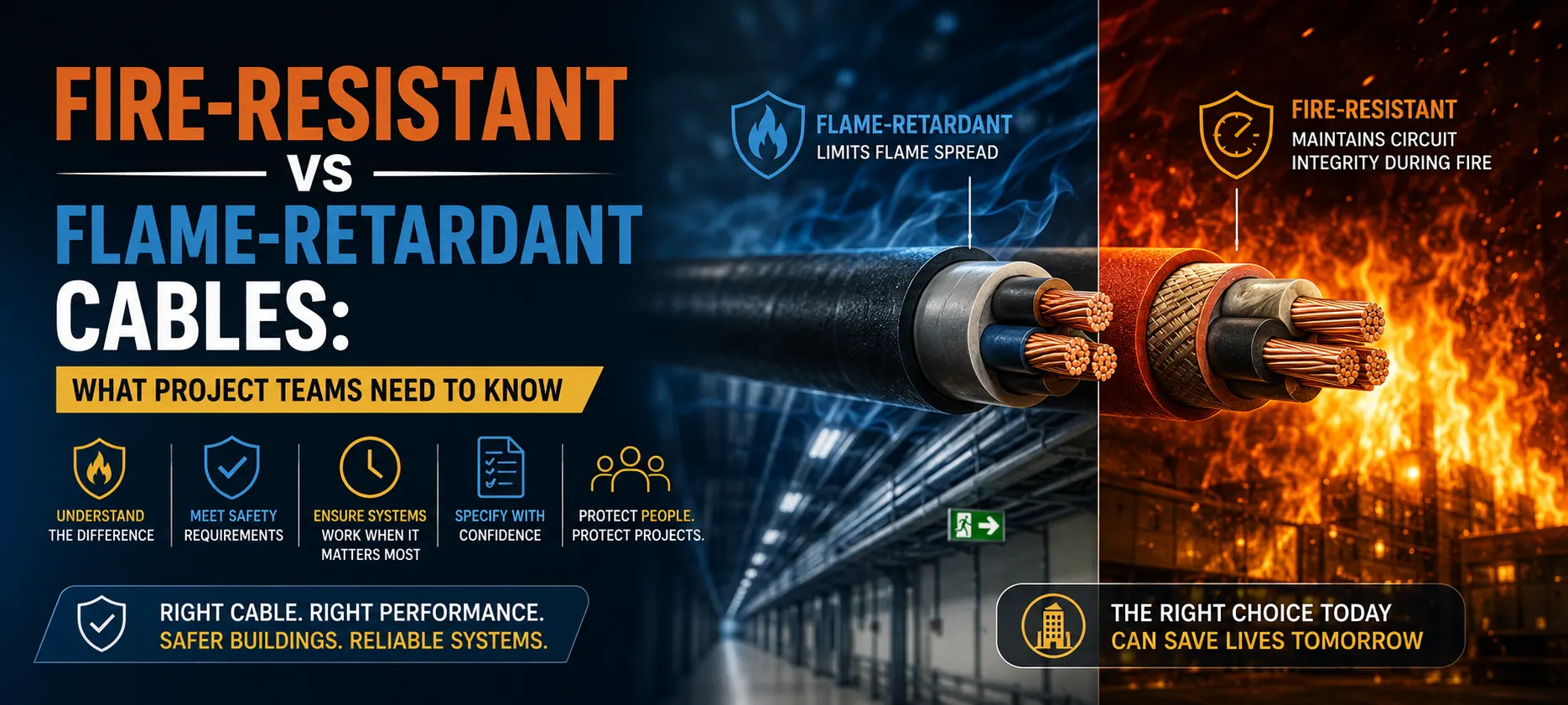
Fire-Resistant vs Flame-Retardant Cables: What Project Teams Need to Know
Cable selection is often treated as a straightforward electrical calculation: determine the current, select the conductor size and choose a suitable insulation system.
But in buildings and infrastructure where fire safety is important, electrical performance is only part of the decision.
The behaviour of a cable during a fire can have a direct effect on life safety, emergency systems and building operations. Some cables are designed to resist flame propagation, while others are designed to continue operating for a specified period during fire exposure.
These two concepts are often confused.
Flame-retardant and fire-resistant cables are not the same thing.
Understanding the difference helps consultants, contractors, procurement teams and facility owners select cables according to the actual function they need to perform during a fire.
What Happens to Cables During a Fire?
When a cable is exposed to fire, several things can happen.
The cable's insulation may begin to soften, decompose or burn. Depending on the cable construction and material, flames may travel along the cable route.
Smoke and combustion products may also be produced.
At the same time, heat can eventually damage the conductor insulation and cause the electrical circuit to fail.
This creates two separate questions:
Will the cable help prevent the fire from spreading?
and
Will the cable continue supplying electrical power during the fire?
These are different requirements, which is why different cable performance classifications exist.
What Is a Flame-Retardant Cable?
A flame-retardant cable is designed to reduce the ability of a flame to spread along the cable.
If the cable is exposed to a flame source, its construction and materials are intended to limit flame propagation under the relevant test conditions.
The objective is primarily to prevent a local fire involving the cable from rapidly travelling along the cable route.
This can be particularly important where large numbers of cables are installed together in:
Cable trays
Shafts
Ceiling spaces
Service corridors
Electrical rooms
Data centres
Industrial facilities
Flame-retardant performance is therefore mainly concerned with limiting fire propagation.
It does not automatically mean that the cable will continue to deliver power throughout a fire.
What Is a Fire-Resistant Cable?
A fire-resistant cable is designed for a different purpose.
Its objective is to maintain circuit integrity for a specified period under defined fire-test conditions.
In simple terms, the cable is designed to continue performing its intended electrical function while exposed to fire for the specified test duration and conditions.
This can be critical for systems that need to remain operational during an emergency.
Examples may include:
Emergency lighting
Fire alarm systems
Smoke-control systems
Fire pumps
Emergency communication systems
Evacuation systems
Critical security systems
Certain life-safety equipment
For these applications, simply preventing flame spread may not be enough.
The circuit may need to continue operating while the fire is being controlled or occupants are being evacuated.
The Key Difference
The easiest way to remember the difference is:
Flame-retardant = limits flame propagation.
Fire-resistant = maintains circuit function during fire for a specified performance period.
A cable can therefore have flame-retardant properties without being suitable for a circuit that must remain operational during a fire.
This distinction is extremely important during project specification.
If a consultant specifies only "fire-rated cable" without clearly defining the required performance, different project teams may interpret the requirement differently.
Why Fire Performance Matters in Buildings
Modern buildings contain large quantities of electrical and communication cabling.
A single cable may not represent a major fire load, but hundreds or thousands of cables installed together can create a significant pathway for fire and smoke propagation.
Cable routes can also connect different parts of a building.
For example, a cable tray may pass through:
Electrical room ? Service shaft ? Floor corridor ? Equipment room
If cable performance and fire-stopping arrangements are poorly designed, fire can potentially travel through these pathways.
This is why cable selection should be considered together with the building's overall fire strategy.
Smoke and Toxicity Also Matter
Fire performance is not limited to whether a flame spreads.
When cable materials burn, they can produce smoke and combustion gases.
In enclosed buildings, smoke can create serious visibility and evacuation problems.
Depending on the project requirements, cable specifications may therefore address additional characteristics such as:
Smoke emission
Halogen content
Toxicity
Corrosive gas emission
Flame propagation
Heat release
Low-smoke and halogen-free cable constructions are often considered for applications where smoke and corrosive combustion products need to be minimised.
However, these properties should not be confused with fire resistance.
A low-smoke cable is not automatically a fire-resistant cable.
Each characteristic should be evaluated separately.
Fire Resistance Does Not Mean "Fireproof"
The term "fire-resistant" can sometimes create unrealistic expectations.
A fire-resistant cable is not indestructible.
Its performance is defined by the applicable test method and specified conditions.
For example, a cable may be tested to maintain circuit integrity for a particular period under controlled fire exposure.
The project team must therefore verify:
Test standard
Test duration
Temperature conditions
Mechanical conditions
Circuit voltage
Cable construction
Installation arrangement
A cable that passes one fire-resistance test should not automatically be assumed to meet every possible fire scenario.
Installation Is Just as Important as Cable Selection
A high-performance cable can still fail to deliver the expected system performance if it is installed incorrectly.
Installation considerations can include:
Cable support
Tray arrangement
Fixing systems
Bending radius
Jointing
Termination
Cable spacing
Penetrations
Fire stopping
For circuits that must remain operational during a fire, the complete installation system may need to maintain integrity.
For example, if a fire-resistant cable is installed on a support system that collapses early in a fire, the cable may no longer remain in its intended position.
This is why project teams should evaluate the cable and its installation method together.
Fire-Stopping at Cable Penetrations
Cables frequently pass through walls, floors and fire-rated compartments.
Whenever a cable penetrates a fire-rated barrier, the penetration must be appropriately addressed.
Otherwise, the cable opening can become a path for:
Fire
Smoke
Hot gases
Suitable fire-stopping systems may be required around cable penetrations depending on the building design and applicable requirements.
The fire performance of the cable itself does not eliminate the need for properly designed compartmentation and penetration sealing.
Selecting Cables for Life-Safety Systems
The first question should be:
Does this circuit need to continue operating during a fire?
If the answer is yes, the project team should identify the required fire-performance level and applicable test requirements.
Potential applications include:
Fire pumps
A fire pump may need a reliable electrical supply during a fire emergency.
Emergency lighting
Emergency lighting helps occupants navigate the building if normal lighting fails.
Fire alarm systems
Fire detection and alarm equipment needs to remain operational during an emergency.
Smoke-control systems
Fans and associated equipment may be required to operate during a fire to manage smoke movement.
Emergency communication
Communication systems may be required to support evacuation and emergency response.
The exact cable requirements should be determined from the applicable building codes, fire strategy, electrical standards and project specifications.
Don't Specify Cables by Marketing Terms Alone
Procurement teams should be careful with descriptions such as:
Fireproof cable
Fire-rated cable
Fire-resistant cable
Flameproof cable
Flame-retardant cable
These terms can be interpreted differently depending on the manufacturer and market.
A better specification identifies the actual performance requirement and the relevant test standard.
The project team should request appropriate documentation, such as:
Manufacturer datasheet
Test certificates
Product construction details
Applicable standard
Fire-performance classification
Installation requirements
This reduces the risk of purchasing a cable that sounds suitable but does not meet the project's actual requirement.
Cable Sizing Still Matters
Fire performance does not replace normal electrical design.
The cable must still be correctly sized for:
Load current
Voltage drop
Ambient temperature
Installation method
Grouping
Short-circuit withstand
Protection coordination
A fire-resistant cable that is electrically undersized is still an unsuitable cable.
The final selection must satisfy both normal operating requirements and fire-performance requirements.
Fire-Resistant Cables and UAE Projects
For projects in the UAE, cable selection should be aligned with the applicable authority requirements, project specifications, building regulations and relevant international standards.
Different projects can have different requirements depending on their use and risk profile.
For example, requirements for a residential building may differ from those for:
Hospitals
Airports
Data centres
Shopping centres
Hotels
Industrial facilities
High-rise buildings
Infrastructure projects
The project team should therefore avoid applying one generic cable specification to every application.
The fire strategy and electrical design should determine where enhanced cable performance is necessary.
A Practical Selection Process
A simple workflow can help project teams make the right decision.
Step 1: Identify the circuit function
Determine what equipment the cable supplies.
Step 2: Ask whether operation is required during fire
If the circuit must continue operating, fire resistance may be required.
Step 3: Determine flame-propagation requirements
Even circuits that do not need to operate during a fire may require suitable flame-retardant characteristics.
Step 4: Check smoke and material requirements
Consider whether low-smoke, halogen-free or other material characteristics are required.
Step 5: Verify the test standard
Do not rely only on product terminology. Confirm the actual test and classification.
Step 6: Check electrical performance
Verify current capacity, voltage drop, short-circuit capability and installation conditions.
Step 7: Check installation requirements
Confirm cable supports, glands, terminations, joints and fire-stopping arrangements.
Step 8: Review certification
Obtain the necessary manufacturer documentation and test evidence.
Common Project Mistakes
Confusing flame-retardant with fire-resistant: The two terms describe different performance objectives.
Selecting only by price: A cheaper cable may not meet the required fire-performance classification.
Ignoring installation supports: Cable performance depends on the complete installation in critical applications.
Forgetting fire-stopping: Cable penetrations can compromise fire compartments.
Relying on marketing terminology: "Fire-rated" should be backed by a clearly defined test classification.
Ignoring smoke performance: Flame resistance alone does not describe smoke or toxic-gas behaviour.
Conclusion
The difference between flame-retardant and fire-resistant cables is simple but extremely important.
Flame-retardant cables are primarily designed to limit the spread of flame along the cable. Fire-resistant cables are designed to maintain circuit integrity for a specified period under defined fire-test conditions.
The right choice depends on what the cable is expected to do during an emergency.
For ordinary power and control circuits, limiting flame propagation may be an important requirement. For life-safety systems such as fire pumps, emergency lighting, fire alarms and smoke-control equipment, maintaining circuit operation during fire may be essential.
Project teams should therefore avoid choosing cables based only on product names or marketing descriptions.
The best approach is to define the required fire performance, verify the applicable standards and test certification, and then ensure that the cable, termination, support and fire-stopping system are all suitable for the application.
Good cable selection is ultimately about more than keeping electricity flowing during normal operation. In critical circuits, it can also help ensure that essential systems remain available when a building needs them most.
Frequently Asked Questions
1. What is the main difference between flame-retardant and fire-resistant cables?
A flame-retardant cable is primarily designed to limit the spread of flame along the cable. A fire-resistant cable is designed to maintain electrical circuit integrity for a specified period under defined fire-test conditions.
2. Does a flame-retardant cable continue working during a fire?
Not necessarily. Flame-retardant performance does not automatically mean that the cable will continue carrying electrical power during fire exposure. If continued operation is required, the project should specify the appropriate fire-resistant performance.
3. Which systems commonly require fire-resistant cables?
Applications can include fire pumps, emergency lighting, fire alarm systems, smoke-control equipment and certain emergency communication or security systems. The exact requirement depends on the applicable regulations, fire strategy and project specification.
4. Are low-smoke and halogen-free cables the same as fire-resistant cables?
No. Low-smoke and halogen-free describe characteristics of smoke and combustion products. They do not automatically indicate that a cable can maintain circuit integrity during a fire.
5. Is the cable itself enough to guarantee fire-safe performance?
No. Installation is also important. Cable supports, terminations, joints, penetrations and fire-stopping systems can all affect the performance of a fire-critical circuit. The complete installation should meet the required design and test criteria.
