
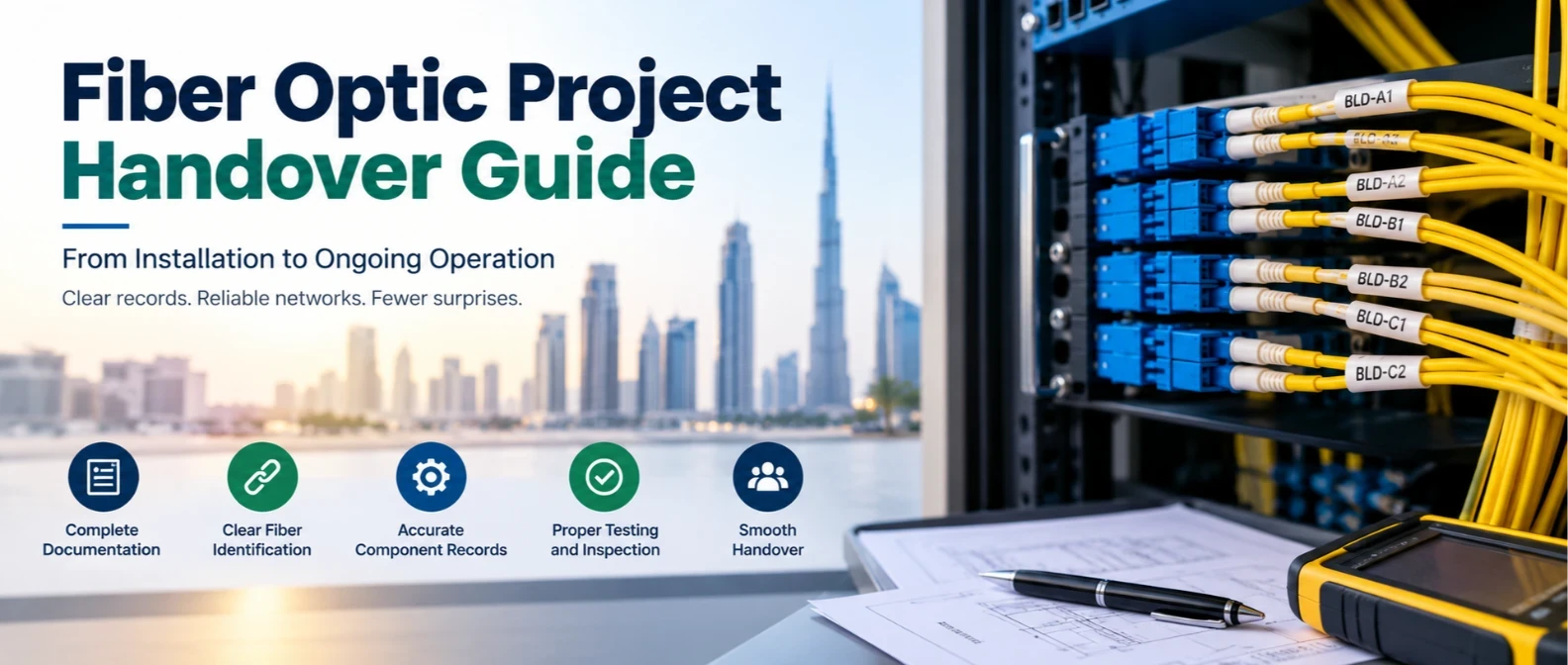
Fiber Optic Network Handover: Testing Records, Identification, and Maintenance Readiness
A fiber optic project is not complete simply because the cable has been installed and a network connection appears to work. The owner also needs to know which fibers connect each location, what was tested, which components were supplied, and how future changes should be managed. Without that information, the first fault or expansion can become an investigation into decisions that were never recorded.
For offices, warehouses, hotels, and campus facilities in the UAE, a clear handover plan makes the transition from construction to operation more orderly. This guide focuses on the coordination, records, and purchasing decisions behind a maintainable fiber network. It helps owners and project teams ask useful questions before acceptance, while leaving technical test limits and methods to the approved specification and qualified specialists.
Agree what completion means before installation
Start by defining the deliverables that the owner expects. These should cover the installed routes, termination locations, fiber identification, test records, component information, and any agreed spare materials. Assign responsibility for each deliverable. If the cabling contractor and network equipment provider have separate contracts, make the boundary between them explicit.
A network that passes traffic during a demonstration does not by itself answer every question about the installed cabling. Acceptance should refer to the agreed scope and documented criteria. Discuss this before the installation programme becomes busy. Late requests for additional reports or different naming formats can require records to be reorganized even when the physical work is already finished.
Connect each fiber to a clear identifier
The handover records should identify the cable, its endpoints, and the fibers within it. Use the naming convention agreed for the project rather than several unrelated systems created by different teams. Keep room, rack, panel, and port references consistent between labels and drawings. A test report is useful only when the owner can connect it to the correct installed link.
Check identifiers before testing begins. If a technician tests a correctly installed link under the wrong name, the result may be difficult to reconcile later. Prepare the test naming file from the controlled schedule where the equipment supports that workflow. After any route or termination change, update the source record before more reports are generated from an outdated version.
Make the component schedule specific
Record the full references for installed cable, panels, adapters, pigtails, patch cords, and other relevant passive components. Include the installed quantities and locations. Where the project has selected a particular connector or fiber arrangement, preserve that detail in the record. A generic entry for fiber accessories gives the maintenance team little help when ordering replacements.
The purchasing team can support this by requiring clear product descriptions from the beginning. Keep approved substitutions with the final schedule instead of leaving the original reference in place after another product has been installed. If a supplier provides a mixed delivery, identify which components belong to which route or rack. The handover should reflect the delivered and accepted installation, not simply repeat the first quotation.
Plan connector inspection and cleaning properly
Connector condition is part of reliable fiber work. Fluke Networks emphasizes inspection and appropriate cleaning before mating fiber connections, including checking again after cleaning. Its fiber optic cleaning guidance explains why a defined process and suitable tools matter. Project teams should make sure the responsible specialists have the specified inspection and cleaning resources available.
For procurement, this means considering the required tools and consumables alongside the cable and panels. For handover, it means documenting the agreed maintenance approach and any equipment transferred to the owner. Do not assume that a generic cleaning product suits every connector arrangement. The team should use products and procedures appropriate to the actual equipment, with manufacturer instructions available to the people carrying out the work.
Define test requirements through the specification
The project specification should state what testing is required and how results will be assessed. The specialist should identify the appropriate instruments, configurations, and reporting method for that scope. Different tests answer different questions, so a folder containing many files is not automatically evidence that all required checks were completed.
Fluke Networks provides technical resources on fiber test methods through its cabling white papers library. These resources illustrate why the method and purpose of a test need to be understood together. For the actual project, agree the required reports with the consultant or owner and retain the relevant instrument and setup details with the results.
Review reports for completeness and traceability
Before acceptance, compare the report list against the final fiber schedule. Check that every required link is represented and that filenames, report identifiers, and installed labels agree. Look for missing endpoints, duplicate names, or reports referring to superseded routes. These administrative mismatches can be identified without attempting to replace the technical assessment performed by the responsible specialist.
Require a clear treatment of failed results and retests. The final package should distinguish accepted results from earlier investigations while preserving whatever history the project requires. Avoid a handover folder in which the owner must guess which of several similar files is final. A short index can identify the accepted report for each link and record any outstanding issue explicitly.
Document the route beyond the rack
Rack elevations and patching schedules explain the endpoints, but the owner may also need to understand how the cable travels between them. Record routes, intermediate enclosures, and access locations at the level required by the project. Where routes are concealed, useful photographs can help preserve information that will be difficult to collect after finishes are complete.
Organize photographs by cable or location reference. An image called cabinet final is less helpful than one linked to a rack identifier and date. Keep sensitive infrastructure records in the access controlled location selected by the owner. The objective is to give authorized staff a dependable map of the installation, rather than scatter copies across personal devices and informal message threads.
Account for spare fibers and spare materials
If spare fibers are part of the installation, identify them clearly in the schedule and show their termination status. Do not leave the owner to infer whether an unused port represents an available fiber, an incomplete connection, or a reserved service. The records should distinguish these conditions using the terminology agreed for the project.
List physical spare materials separately from spare capacity in the installed cable. Patch cords, adapters, or other agreed items should have identifiable references and quantities. Store them according to the relevant product guidance and hand them over with a signed inventory. A box of unlabelled accessories may contain useful parts, but it does not provide a reliable basis for future maintenance planning.
Prepare the operations team for ordinary changes
Handover should explain how the owner will record moves, additions, and patching changes. Decide who maintains the patching schedule and how updates are approved. If the record is stored in a shared system, confirm that the operations team can access and edit it using the intended permissions. A complete document that no one can update becomes outdated quickly.
A short walkthrough can demonstrate the relationship between labels, drawings, and test files. Use an actual link as the example and follow its identifiers from one endpoint to the other. This gives the owner an opportunity to identify confusing terms before the contractor leaves. Record any questions that need followup so the walkthrough produces practical improvements rather than becoming only a signature exercise.
A campus handover example
Imagine a facility with an office building and two warehouse blocks connected by fiber. Each installer has labelled links using a different building abbreviation. The test reports appear complete, but some names refer to construction zone numbers that the facilities team does not use. Finding the record for a particular link requires asking the original technician.
The project team resolves this by agreeing one set of building and rack identifiers, updating the labels, and mapping the accepted reports to the final schedule. Route drawings and spare fiber records use the same references. The physical cable has not changed, but the owner can now understand and maintain the installation with less dependence on personal memory.
Keep an issue list until acceptance is clear
Separate completed deliverables from unresolved items. Each open issue should identify the affected link or record, the required action, the responsible party, and the agreed completion date. This makes it possible to track progress without repeatedly reviewing the entire handover package. Avoid vague entries that cannot be closed objectively.
When an issue is resolved, update the relevant final document as well as the issue list. Otherwise, an email may confirm that a correction was made while the handover folder still contains the old information. Keep the final package in a clearly identified location with a revision date. A tidy closeout record reduces confusion when another contractor later joins the maintenance team.
Request supplies with handover in mind
A useful fiber materials enquiry includes the approved cable and connector requirements, rack arrangements, quantities, spare material needs, and required documentation. It also distinguishes the passive cabling scope from network equipment and testing services. Clear boundaries help each supplier respond accurately and expose missing responsibilities before the project reaches acceptance.
For fiber optic cabling and related accessory enquiries, contact Abyad Al Nasea Electricals Trading LLC at sales@abyadae.com. Share the project schedule and approved requirements so that product options and availability can be discussed. Planning for records, identification, and support materials from the start helps the finished network remain understandable after installation is complete.
