
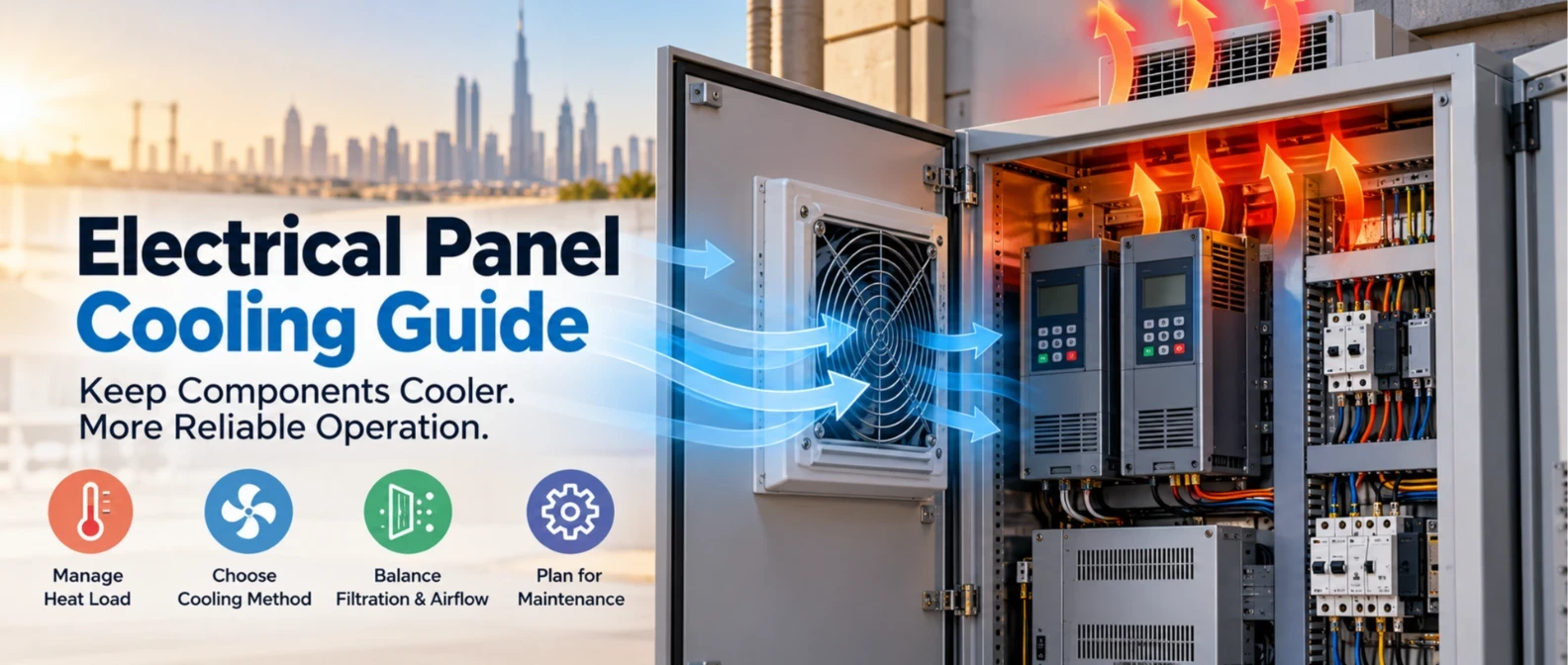
Electrical Panel Cooling in the UAE: Fans, Filters or Air Conditioning?
An electrical panel can contain correctly rated components and still operate poorly if heat is not managed. Drives, power supplies, transformers, and other equipment release heat inside an enclosure. Outdoor exposure and warm service rooms add further challenges for UAE facilities. Selecting a fan by its physical size alone will not establish an effective cooling strategy. Begin with the heat load, permitted component temperatures, site conditions, and enclosure requirements. This guide explains the information needed to compare ventilation and active cooling options intelligently.
For example, a facility adding two drives to an existing cabinet should obtain their loss figures and revise the heat balance before choosing a fan. The new layout may also block the original air path. Compare the existing cabinet temperature under load with the revised design assumptions, then check the proposed cooling method at the relevant ambient condition. Record the result and the required filter inspection interval. This turns the upgrade into a reviewable change instead of a sequence of larger fans fitted whenever a temperature alarm returns.
Establish the heat load before choosing equipment
Use manufacturer loss data for each component at its expected operating condition. Add the relevant losses and identify which devices run together. Installed electrical capacity is not the same as heat released inside the cabinet. A drive's motor power rating, for example, does not represent the drive's own internal heat dissipation. The panel designer should prepare a heat balance using documented assumptions. Record ambient conditions, cabinet dimensions, exposure, and permitted internal temperature so the calculation can be reviewed when equipment changes.
Measure existing conditions where a panel is already operating. Useful records include room temperature, temperatures at relevant locations inside the enclosure, load pattern, and alarm history. Collect observations over representative operating periods rather than relying on one cool morning. Keep measurement methods consistent and use appropriate equipment and qualified personnel. If a problem only appears during peak production, readings from an idle panel may not explain it. These records help distinguish inadequate cooling from a failing component or an unusual operating condition.
Understand what ventilation can achieve
Fan ventilation exchanges cabinet air with surrounding air. It can remove internally generated heat when the external air is sufficiently cooler than the acceptable internal temperature. It cannot make the panel colder than its intake air. If the ambient environment already exceeds a component's permitted conditions, adding airflow may not solve the problem. A ventilation calculation must therefore consider both heat removal and the temperature difference available. Avoid assuming that a higher airflow number always makes a particular fan arrangement suitable.
Airflow should reach the heat producing components instead of taking a short path directly from intake to outlet. Component spacing, cable ducts, barriers, and cabinet geometry influence that route. Check the manufacturer's mounting recommendations and keep required clearances around equipment. Fan ratings obtained under free air conditions may differ from airflow through filters and installed openings. Ask the cooling supplier for performance information relevant to the complete arrangement. A large fan fitted to a restricted opening can deliver disappointing practical results.
Balance dust protection with airflow
Filters reduce the entry of airborne contamination, but they need maintenance and introduce resistance to airflow. In dusty locations, a filter can become blocked well before a general annual inspection. The maintenance interval should reflect actual contamination and operating conditions. Specify accessible filter positions and a suitable replacement supply. A cooling system that requires awkward shutdowns for routine filter changes may be neglected. Include the expected inspection method in the panel handover so ownership of that work is clear.
Openings and cooling accessories can affect the enclosure's environmental protection. Confirm the rating of the assembled cabinet with the selected fan, filter, seal, and installation method. The original empty enclosure rating does not automatically describe a modified panel. Water exposure, washdown, airborne chemicals, and coastal conditions can change the requirements. Where contaminated external air must be excluded, a closed cooling arrangement may deserve consideration. The final choice should address ingress protection and corrosion resistance as well as the ability to remove heat.
Know when active cooling is needed
An enclosure air conditioner can provide cooling when ventilation cannot meet the required temperature conditions. Selection still requires the heat load, ambient range, installation arrangement, and performance data. A nominal cooling capacity quoted at one temperature may not apply at the site's worst operating condition. Compare the relevant performance curves rather than a single headline value. Check electrical supply, protection, condensate arrangements, service clearances, and how failure alarms will reach the facility team. These details belong in the procurement specification.
A heat exchanger may transfer heat while limiting the exchange of internal and external air. Its usefulness depends on the available temperature difference and the chosen technology. Neither a heat exchanger nor an air conditioner should be selected as a generic cure for all panels. Discuss the environment and required internal conditions with the panel designer. Maintenance requirements, energy consumption, service capability, and replacement availability should be considered alongside the initial equipment price. A cooling method must remain practical throughout the panel's service life.
Manage condensation and operating controls
Cooling a cabinet too aggressively can create moisture problems in some conditions. Temperature control should be chosen with the environment, component requirements, and condensation risk in mind. Door openings, changes in humidity, and periods when equipment is stopped can affect the internal conditions. Ask the designer whether heaters, humidity control, or particular operating sequences are needed. A thermostat setting borrowed from another installation may be inappropriate. Keep the approved control settings documented and discourage casual adjustments made only to silence an alarm.
Specify what happens when a fan stops or cooling capacity becomes unavailable. Depending on the application, temperature monitoring may trigger an alarm or a controlled response. The decision should consider the equipment and operational risk. Do not assume that the presence of a fan provides continuous protection without monitoring. During commissioning, verify the cooling arrangement under a representative load and confirm that alarms are received by the intended personnel. A test of fan rotation alone does not demonstrate that all components remain within permitted conditions.
Prepare a complete cooling enquiry
Provide cabinet dimensions, enclosure construction, installation location, heat dissipation estimate, component temperature limits, and ambient assumptions. Include photographs or layout drawings showing available mounting surfaces and airflow obstructions. State ingress requirements and any restrictions on external air exchange. Add the power supply, required alarms, maintenance access, and delivery programme. This information helps suppliers propose relevant equipment rather than guessing from the cabinet's height. For enquiries about enclosures and associated components, explore our electrical products before submitting the project requirements.
When comparing offers, ask each supplier to identify the conditions used to establish cooling capacity. Confirm accessories, cutout dimensions, sealing requirements, and service support. Keep the original calculation with the panel records and review it whenever drives or power supplies are added. Changes that appear minor electrically can increase cabinet losses or obstruct airflow. A spare space on a mounting plate does not necessarily mean that there is spare thermal capacity. That check is especially useful when production teams request rapid modifications to existing equipment.
A practical maintenance question
Should every UAE panel have an air conditioner? No single cooling method suits every installation. The right approach follows the heat balance and environment. A clean indoor panel with a modest heat load may have different needs from an exposed cabinet containing drives. Before purchasing, have the designer establish those needs and send the resulting specification through our contact page.
Technical reference: Manufacturer information. Checked October 2026; verify the current documentation for the exact product before ordering.
Related reading: Enclosure IP ratings.
